
Executive Summary
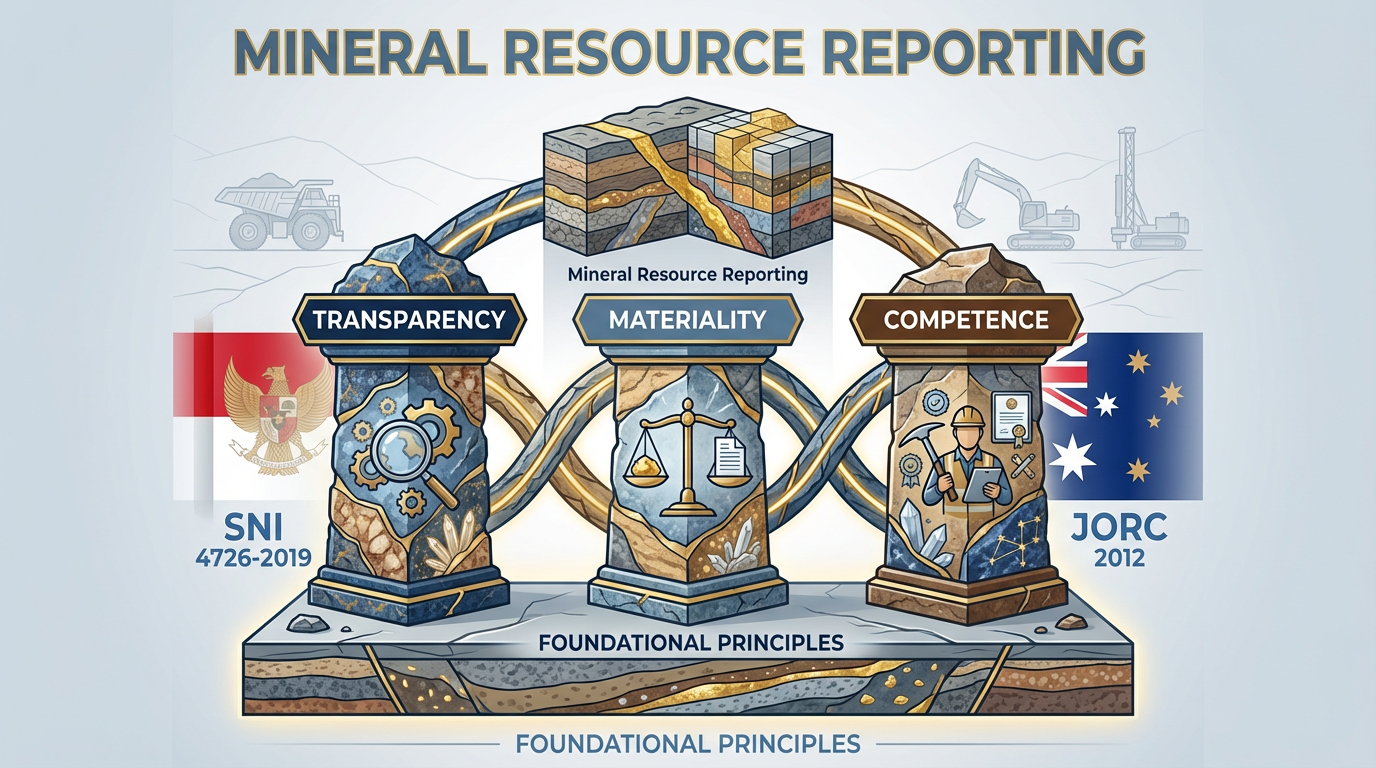
This report presents a comprehensive crosswalk analysis comparing SNI 4726-2019 (Indonesian National Standard for Reporting Exploration Results, Mineral Resources, and Mineral Reserves) with JORC 2012 (Australasian Code for Reporting of Exploration Results, Mineral Resources and Ore Reserves). Both codes are built on identical foundational principles—Transparency, Materiality, and Competence—and share substantially similar classification frameworks for mineral resources and reserves. The analysis reveals strong alignment in definitions, classification hierarchies, technical requirements, and reporting standards, with differences primarily reflecting jurisdictional contexts and regulatory emphases. SNI provides more detailed guidance on Indonesian regulatory requirements and prescriptive technical specifications, while JORC emphasizes stock exchange compliance and comprehensive disclosure checklists. The codes are functionally equivalent for resource and reserve classification purposes, enabling practitioners to apply consistent technical methodologies across both jurisdictions with appropriate adaptation of reporting format and emphasis.
1. Introduction
1.1 Purpose and Scope
This crosswalk analysis provides a detailed comparison of two major mineral reporting codes: the Indonesian National Standard SNI 4726-2019 and the Australian JORC Code 2012 Edition. The analysis is designed to support mining professionals, regulators, investors, and technical practitioners who work across Indonesian and Australian/international jurisdictions. The report systematically compares definitions, classification criteria, reporting requirements, competent person qualifications, and technical assessment standards to identify alignments, differences, and practical implications for cross-jurisdictional reporting [1], [2].
1.2 Background
Both SNI 4726-2019 and JORC 2012 serve as authoritative frameworks for public reporting of mineral exploration results, resources, and reserves. SNI 4726-2019 was developed to provide Indonesian mining industry stakeholders with standardized reporting guidelines aligned with international best practices while addressing specific Indonesian regulatory and operational contexts [1]. JORC 2012, widely recognized internationally, establishes standards for reporting to the Australian Securities Exchange (ASX) and New Zealand Stock Exchange (NZX), and has influenced numerous other national reporting codes globally [2].
1.3 Methodology
This analysis draws on comprehensive comparative research conducted through detailed examination of both code documents. The methodology involved systematic extraction and comparison of key elements including definitions, classification criteria, reporting requirements, competent person qualifications, and technical assessment standards. The analysis identifies direct equivalencies, functional similarities, and material differences between the codes [1], [2].
2. Foundational Principles Comparison
2.1 Core Principles
Both SNI 4726-2019 and JORC 2012 are founded on three identical core principles that govern all aspects of mineral reporting: Transparency, Materiality, and Competence [1], [2].
Transparency Principle:
SNI 4726-2019 requires that reports present sufficient information with clear presentation that is unambiguous and not confusing to stakeholders [1]. Similarly, JORC 2012 mandates that readers be provided sufficient information through clear and unambiguous presentation, ensuring reports do not mislead through information provided or omission of material information known to the Competent Person [2].
Materiality Principle:
Under SNI 4726-2019, reports must contain all relevant, appropriate, and reasonable information necessary for proper and balanced decision-making [1]. JORC 2012 defines materiality as requiring reports to contain all relevant information that investors and professional advisers would reasonably require and expect for making a reasoned and balanced judgment, with any exclusion of relevant information requiring justification [2].
Competence Principle:
Both codes require that public reports be based on work undertaken by, or under the supervision of, suitably qualified and experienced persons who are subject to an enforceable professional code of ethics [1], [2]. This principle ensures technical credibility and professional accountability in all reported information.
2.2 Principle Application
The application of these principles is consistent across both codes, requiring that all public reports on exploration results, mineral resources, and mineral reserves adhere to these standards. The principles serve as overarching guidelines that inform specific requirements throughout each code, from data collection and analysis through to public disclosure [1], [2].
3. Core Definitions and Terminology
3.1 Exploration Results
SNI 4726-2019 Definition:
Exploration results are defined as data and information obtained from exploration programs that are useful to stakeholders but are not considered part of a mineral resource or reserve statement [3]. These results provide an overview of the size and type of mineralization but do not constitute resource or reserve estimates; they are referred to as ‘exploration targets’ and should be reported as target ranges with detailed geological concept explanations [4]. The code explicitly prohibits the use of terms “resource” or “reserve” when reporting exploration results [4].
JORC 2012 Definition:
JORC 2012 defines exploration results as data and information from mineral exploration programs that may be useful to investors but do not yet constitute a declaration of Mineral Resources or Ore Reserves [2]. Such information is typically reported in early exploration stages when data is insufficient for reasonable Mineral Resource estimates, including examples such as outcrop sampling, drill hole intersection assays, geochemical results, and geophysical survey results [2], [3]. The code similarly prohibits use of the terms “Resource” or “Reserve” in this context [2].
Alignment Analysis:
The definitions are functionally identical. Both codes define exploration results as pre-resource data that cannot be termed resources or reserves, require reporting as ranges with geological context, and emphasize that such results represent preliminary information insufficient for resource classification [3], [4], [2].
3.2 Mineral Resources
SNI 4726-2019 Definition:
A Mineral Resource is defined as a concentration of minerals with economic value in the Earth’s crust, with specific dimensions, quality, and quantity showing reasonable prospects for eventual economic extraction [6]. The location, quantity, grade, geological characteristics, and continuity must be known, estimated, or interpreted from specific geological evidence and sampling [6]. Mineral Resources are classified by increasing geological confidence into three categories: Tereka (Inferred), Tertunjuk (Indicated), and Terukur (Measured) [6].
JORC 2012 Definition:
JORC 2012 defines a Mineral Resource as a concentration of solid material of economic interest in or on the Earth’s crust with reasonable prospects for eventual economic extraction [4]. Location, quantity, grade, continuity, and other geological characteristics are known, estimated, or interpreted from specific geological evidence and sampling [4]. Resources are classified by increasing geological confidence as Inferred, Indicated, and Measured [4].
Alignment Analysis:
The definitions are virtually identical in substance and structure. Both require demonstration of reasonable prospects for eventual economic extraction and use the same three-tier classification system based on increasing geological confidence. The key phrase “reasonable prospects for eventual economic extraction” appears in both codes, establishing the same threshold for resource classification [6], [4].
3.3 Mineral Reserves / Ore Reserves
SNI 4726-2019 Definition:
A Mineral Reserve (Cadangan Mineral) is defined as the economically mineable part of Indicated and/or Measured resources [13]. The classification requires a minimum Pre-Feasibility Study level with comprehensive consideration of modifying factors including technical mining, processing, metallurgy, infrastructure, economic, marketing, legal, environmental, social, and regulatory aspects [13], [14]. Reserves must demonstrate technical feasibility and economic viability, include dilution and mining losses, and are classified as Cadangan Terkira (Probable) and Cadangan Terbukti (Proved) [13], [14], [15], [17].
JORC 2012 Definition:
An Ore Reserve is defined as the economically mineable part of a Measured and/or Indicated Mineral Resource [11]. The classification requires Pre-Feasibility or Feasibility level studies with modifying factors applied, includes diluting materials and allowances for losses, and must demonstrate that extraction can be reasonably justified at the time of reporting [11]. Reserves are classified as Probable Ore Reserve and Proved Ore Reserve [11], [12], [13].
Alignment Analysis:
The definitions are identical in all material aspects. Both require Pre-Feasibility Study as the minimum level, consideration of comprehensive modifying factors, inclusion of dilution and losses, and use the same two-tier classification system (Probable/Proved). The terminology differs only in that SNI uses “Mineral Reserve” while JORC uses “Ore Reserve,” but the technical definitions and requirements are equivalent [13], [14], [11].
4. Classification System Crosswalk
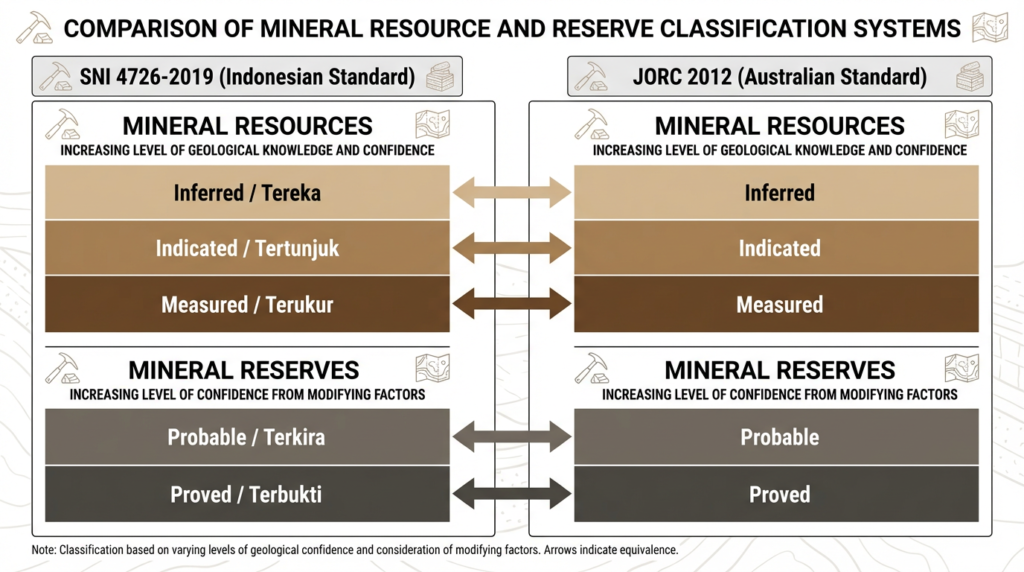
4.1 Resource Classification Hierarchy
Both codes employ an identical three-tier classification system for Mineral Resources based on increasing levels of geological confidence and data quality.
4.1.1 Inferred / Tereka Resources
SNI 4726-2019 Criteria:
Inferred Mineral Resources (Sumber Daya Mineral Tereka) represent the lowest confidence category where tonnage, density, shape, dimensions, chemistry, and grade can only be estimated with low confidence [7]. Observation points may be supported by data, but geological confidence is insufficient to verify the continuity of the mineral deposit and its grade [7]. This category has lower confidence than Indicated Resources and cannot be converted to mineral reserves [8]. The data is adequate to show occurrence but not to verify continuity [7].
JORC 2012 Criteria:
Inferred Mineral Resources are estimates based on limited geological evidence and sampling, implying but not verifying geological and grade continuity [5], [6]. This category has lower confidence than Indicated Mineral Resources and cannot be converted to an Ore Reserve [5], [6]. The geological evidence is insufficient to confidently interpret geological and grade continuity [5]. While most Inferred Resources are expected to upgrade to Indicated with further exploration, this is not guaranteed [6].
Comparative Analysis:
Both codes define Inferred/Tereka resources identically as the lowest confidence category with limited geological evidence, insufficient data to verify continuity, and explicit prohibition on conversion to reserves. The key alignment is the shared restriction that Inferred resources cannot be directly converted to reserves under any circumstances [7], [8], [5], [6].
4.1.2 Indicated / Tertunjuk Resources
SNI 4726-2019 Criteria:
Indicated Mineral Resources (Sumber Daya Mineral Tertunjuk) have reasonable confidence in tonnage, density, shape, dimensions, chemistry, and grade estimation based on information from observation points [9]. The geological evidence is sufficiently detailed and reliable to assume geological and grade continuity between observation points [10]. This category has lower confidence than Measured Resources and can only be converted to Probable Mineral Reserves [10]. The data supports mine planning and economic feasibility evaluation [10].
JORC 2012 Criteria:
Indicated Mineral Resources have sufficient confidence in quantity, grade, densities, shape, and physical characteristics to allow application of Modifying Factors for mine planning and economic viability evaluation [7]. Geological evidence is detailed and reliable enough to assume geological and grade continuity [7]. This category has lower confidence than Measured Resources and may only be converted to a Probable Ore Reserve [8].
Comparative Analysis:
The criteria are identical. Both codes require reasonable/sufficient confidence for modifying factors application, detailed and reliable geological evidence to assume continuity, and permit conversion only to Probable reserves. The functional equivalence enables direct cross-referencing between the codes for this classification level [9], [10], [7], [8].
4.1.3 Measured / Terukur Resources
SNI 4726-2019 Criteria:
Measured Mineral Resources (Sumber Daya Mineral Terukur) represent the highest confidence category where tonnage, density, shape, dimensions, chemistry, and grade can be estimated with high confidence based on information from closely spaced observation points and high geological confidence [11]. Observation points are sufficiently close to prove grade and mineral content continuity [11]. This category can be converted to Proved or Probable Mineral Reserves [12]. SNI specifies that Measured resources support Scoping Study level economic assessment [11].
JORC 2012 Criteria:
Measured Mineral Resources have confidence sufficient for detailed mine planning and final economic viability evaluation [9]. Geological evidence is derived from detailed and reliable exploration, sampling, and testing, confirming geological and grade continuity [9]. This category may be converted to a Proved Ore Reserve or, in some circumstances, a Probable Ore Reserve [10]. JORC emphasizes support for detailed mine planning and final economic evaluation [9].
Comparative Analysis:
Both codes define Measured/Terukur as the highest confidence resource category with detailed, reliable data from close-spaced observation points proving continuity. Both permit conversion to Proved or (under certain circumstances) Probable reserves. A minor difference exists in emphasis: SNI specifies Scoping Study level for Measured resources, while JORC emphasizes detailed mine planning and final evaluation without specifying study level at the resource stage [11], [12], [9], [10].
4.2 Reserve Classification Hierarchy
Both codes employ an identical two-tier classification system for Mineral/Ore Reserves based on confidence levels in the underlying resources and modifying factors.
4.2.1 Probable / Terkira Reserves
SNI 4726-2019 Criteria:
Probable Mineral Reserves (Cadangan Mineral Terkira) are the economically mineable part of an Indicated Mineral Resource, and in some cases, a Measured Mineral Resource [15]. This category includes dilution and lost material, requires appropriate studies demonstrating that extraction is justified, and has lower confidence than Proved Mineral Reserves but is sufficient for mine development decisions [15], [16].
JORC 2012 Criteria:
Probable Ore Reserves are the economically mineable part of an Indicated, and in some circumstances, a Measured Mineral Resource [12]. The confidence in the Modifying Factors for a Probable Ore Reserve is lower than for a Proved Ore Reserve [12].
Comparative Analysis:
The definitions and conversion pathways are identical. Both codes derive Probable reserves primarily from Indicated resources (with allowance for Measured resources under certain circumstances), include dilution and losses, and represent lower confidence than Proved reserves [15], [16], [12].
4.2.2 Proved / Terbukti Reserves
SNI 4726-2019 Criteria:
Proved Mineral Reserves (Cadangan Mineral Terbukti) are the economically mineable part of a Measured Mineral Resource [17], [18]. This category includes dilution and lost ore, requires appropriate studies demonstrating that mining is justified, and represents the highest level of confidence in reserve estimation [17], [18], [19].
JORC 2012 Criteria:
Proved Ore Reserves are the economically mineable part of a Measured Mineral Resource, implying a high degree of confidence in the Modifying Factors [13]. This represents the highest confidence category for reserve estimates, reflecting high confidence in geological and grade continuity [13].
Comparative Analysis:
The definitions are identical. Both codes require Proved reserves to be derived exclusively from Measured resources, represent the highest confidence level, and imply high confidence in both geological continuity and modifying factors [17], [18], [19], [13].
4.3 Conversion Pathways
The conversion pathways from resources to reserves are identical in both codes:
- Inferred/Tereka Resources: Cannot be converted to reserves under any circumstances [8], [5], [6]
- Indicated/Tertunjuk Resources: May only be converted to Probable reserves [10], [8]
- Measured/Terukur Resources: May be converted to Proved reserves or, under certain circumstances, Probable reserves [12], [10]
This alignment ensures consistent treatment of resource-to-reserve conversion across both jurisdictions [8], [10], [12], [5], [6], [8], [10].
5. Competent Person Requirements
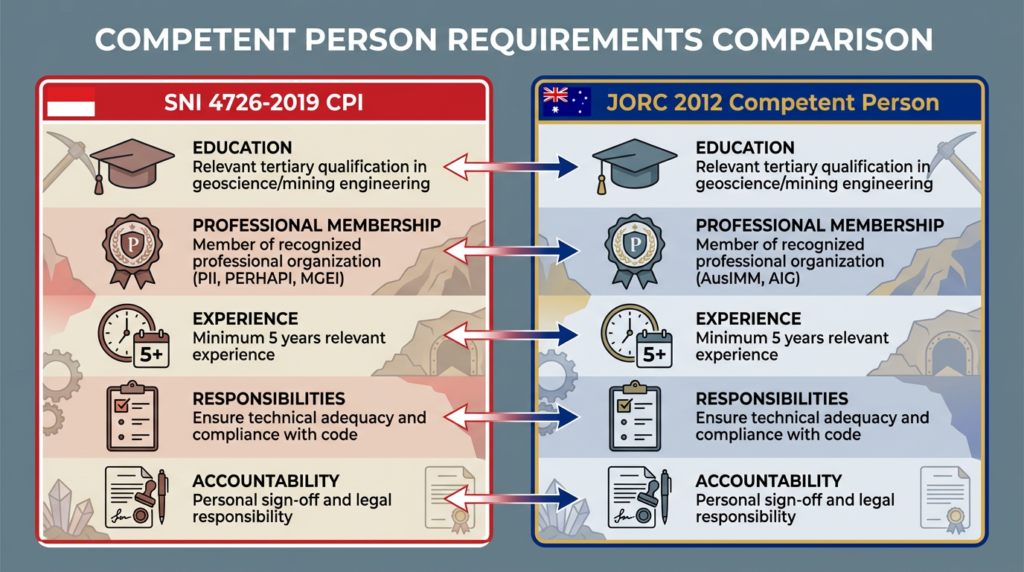
5.1 Qualifications and Experience
SNI 4726-2019 Requirements:
The Competent Person (Orang yang Berkompeten) must have at least 5 years of relevant experience in reporting exploration results and/or estimating mineral resources and/or reserves [23]. The individual must possess knowledge, ability, and experience appropriate to the reporting activity, proven with a competency certificate in accordance with prevailing Indonesian regulations [23]. The Competent Person must be bound by professional rules and a code of ethics [1].
JORC 2012 Requirements:
A Competent Person must have a minimum of 5 years of relevant experience in the specific style of mineralization or type of deposit and the activity they are undertaking [21]. The individual must be professionally qualified in a relevant discipline and be a Member or Fellow of The Australasian Institute of Mining and Metallurgy (AusIMM), the Australian Institute of Geoscientists (AIG), or a Recognised Professional Organisation (RPO) with enforceable disciplinary processes [20]. The Competent Person must be subject to an enforceable professional code of ethics [20].
Comparative Analysis:
Both codes require identical minimum experience of 5 years in relevant activities. The key difference lies in credentialing mechanisms: SNI requires government-recognized competency certification per Indonesian regulations, while JORC requires membership in specific professional organizations (AusIMM, AIG, or RPO) with enforceable disciplinary processes. Both require adherence to professional codes of ethics, ensuring accountability and professional standards [23], [1], [21], [20].
5.2 Activity-Specific Experience
SNI 4726-2019:
The Competent Person’s experience must be relevant to the specific activity being undertaken—reporting exploration results and/or estimating resources and/or reserves [23].
JORC 2012:
JORC explicitly specifies that experience must be activity-specific: exploration experience for Exploration Results, estimation experience for Mineral Resources, and assessment of economic extraction for Ore Reserves [21].
Comparative Analysis:
Both codes require activity-specific experience, though JORC provides more explicit delineation of the three activity categories. The underlying principle is identical: the Competent Person must have directly relevant experience in the specific type of work being reported [23], [21].
5.3 Responsibilities and Accountability
SNI 4726-2019 Requirements:
The Competent Person must be willing to be responsible and accountable for report content by signing the document [25]. When preparing mineral reserve reports, the Competent Person must visit the project site and include a visit summary covering location, observations, issues, and recommendations [26]. When relying on work from other experts, the Competent Person must assess the reasonableness of their work before using it [25]. In team efforts, each competent person’s contribution must be identified in the report [25]. The Competent Person must perform database and geological model verification and validation before reserve estimation [24].
JORC 2012 Requirements:
Public reports must be issued with the prior written consent of the Competent Person regarding the form and context of their information [22], [23]. Completion of a Competent Person’s Consent Form is recommended as good practice [24]. The Competent Person must disclose any potential conflicts of interest and relationships with the reporting company [22]. The company must disclose the Competent Person’s name, employment status, and employer if not a company employee [22]. Site visits are required with outcome commentary; if not undertaken, an explanation must be provided [2].
Comparative Analysis:
Both codes emphasize personal accountability and responsibility. SNI explicitly mandates site visits for reserve reports, while JORC requires site visits but allows explanation if not undertaken. JORC places greater emphasis on written consent documentation and conflict of interest disclosure, while SNI emphasizes verification and validation of databases and models. Both approaches ensure professional accountability, though through slightly different mechanisms [25], [26], [24], [22], [23], [24], [2].
6. Public Reporting Requirements
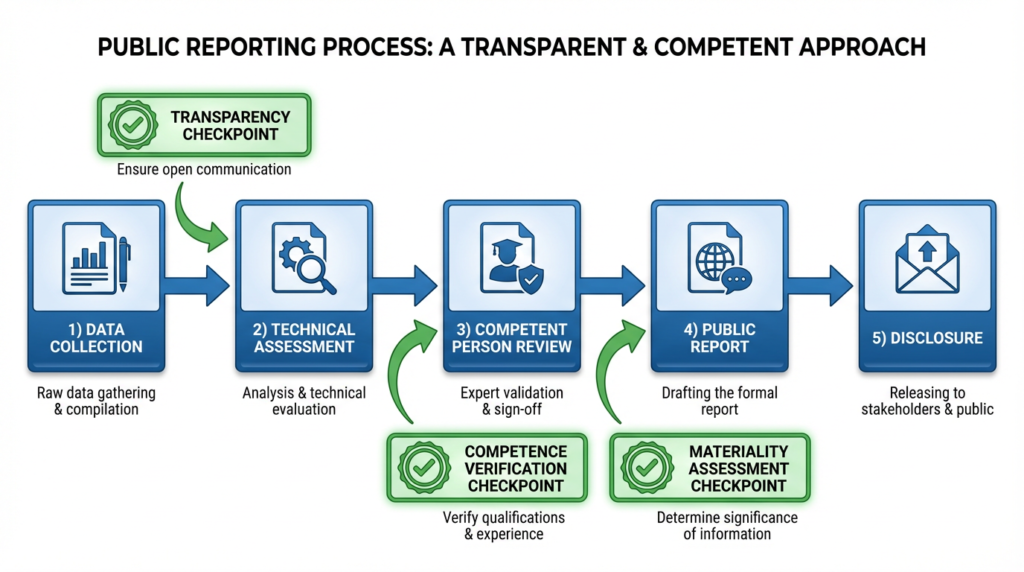
6.1 Transparency Requirements
SNI 4726-2019:
Reports must present sufficient information with clear, unambiguous, and non-confusing presentation [1]. Exploration reports must contain sufficient information for balanced assessment of significance, including context, sampling methods, intervals, locations, data distribution, assay data, aggregation methods, and land tenure status [20]. Selective reporting of isolated assays or samples without proper context is unacceptable [4].
JORC 2012:
Readers must be provided sufficient information through clear and unambiguous presentation [2]. Reports must not mislead by information provided or omission of material information known to the Competent Person [2]. JORC provides extensive Table 1 checklist criteria covering sampling techniques, drilling, logging, assay quality, data verification, and location accuracy [2].
Comparative Analysis:
Both codes require comprehensive, clear, unambiguous reporting with detailed technical information. JORC provides more extensive checklist criteria through its Table 1 framework, offering detailed guidance on specific technical aspects. The fundamental transparency requirements are identical, with JORC providing more structured implementation guidance [1], [20], [4], [2].
6.2 Materiality Requirements
SNI 4726-2019:
Reports must contain all relevant, appropriate, and reasonable information necessary for proper and balanced decision-making [1].
JORC 2012:
Reports must contain all relevant information that investors and advisers would reasonably require and expect for making a reasoned and balanced judgment [2]. Where relevant information is not supplied, an explanation must justify the exclusion [2].
Comparative Analysis:
Both codes define materiality identically in principle. JORC explicitly requires justification for excluded information, providing additional procedural clarity. The core requirement—inclusion of all material information for informed decision-making—is identical [1], [2].
6.3 Resource Reporting Standards
SNI 4726-2019:
Public reports on mineral resources must explicitly state one or more categories (Inferred, Indicated, or Measured) and should not combine categories unless detailed breakdowns are provided [21]. Mineral resources should not be reported as metal content or mineral content without associated tonnage and grade [21]. Resources must not be combined with reserves [21].
JORC 2012:
Mineral Resources must specify category clearly and be reported separately with increasing geological confidence [4]. Tonnage and grade must be reported [4]. Resources are reported separately from reserves [4].
Comparative Analysis:
The reporting requirements are identical. Both codes prohibit combined category reporting without individual disclosure, require tonnage and grade specification, and mandate separation of resources from reserves. This alignment ensures consistent presentation standards across jurisdictions [21], [4].
6.4 Reserve Reporting Standards
SNI 4726-2019:
Reports on mineral reserves must explicitly state either or both Proved and Probable categories and should not combine them unless relevant figures for each are shown [22]. Metal or mineral content should not be presented without associated tonnage and grade [22].
JORC 2012:
Ore Reserves must state Proved and/or Probable categories and show relevant figures for each category [11]. Reports must include tonnage and grade [11]. JORC additionally requires annual public reporting with nominated review dates and discussion of material changes [18].
Comparative Analysis:
Both codes require clear category specification, prohibition on combined reporting without individual disclosure, and tonnage/grade presentation. A key difference is that JORC explicitly mandates annual public reporting with effective dates and discussion of material changes, while SNI does not specify annual reporting frequency. This reflects JORC’s emphasis on ongoing stock exchange compliance [22], [11], [18].
7. Technical Requirements and Assessment Criteria
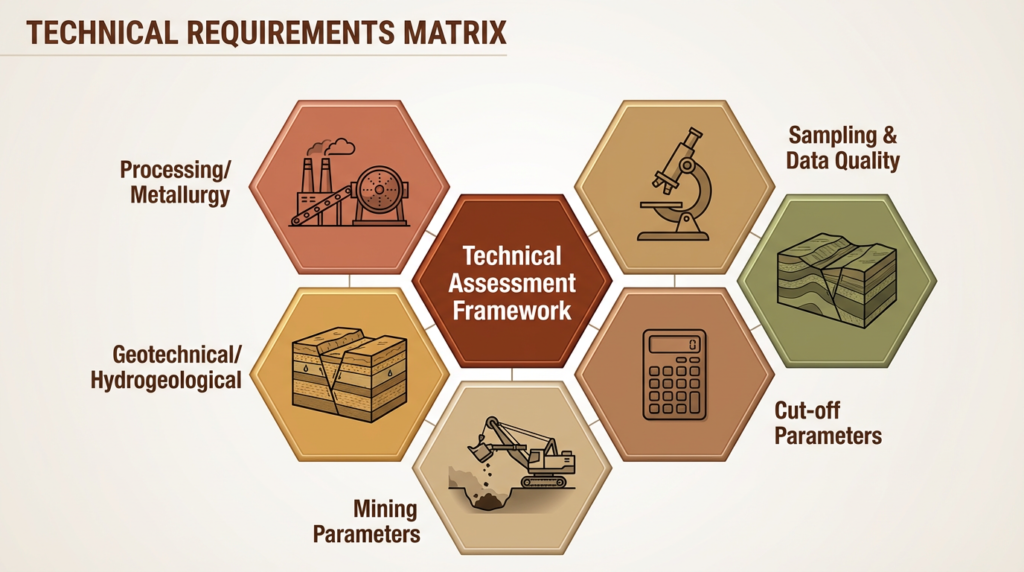
7.1 Sampling and Data Quality
SNI 4726-2019 Requirements:
Core recovery must be ≥95%; if recovery is <95% due to geological factors, the Competent Person must provide explanation [31]. Statistical analysis must include sample count, minimum/maximum values, mean/median, standard deviation, variance, coefficient of variation, standard error, and confidence limits [29]. Sampling techniques must represent spatial distribution and variability of important parameters [31]. Mineralization and geological structure correlation must be confirmed using cross-sections, longitudinal sections, and horizontal sections [32].
JORC 2012 Requirements:
Documentation must cover recovery methods, measures to maximize recovery, and the relationship between recovery and grade [30]. Data quality and distribution must be sufficient for resource classification [25]. Sample representivity must be ensured with appropriate calibration of measurement tools [30]. Geological interpretation must control resource estimates [33].
Comparative Analysis:
Both codes emphasize rigorous data quality standards and sample representivity. A key difference is that SNI specifies a precise 95% core recovery threshold with explanation required if lower, while JORC requires documentation of recovery relationships without specifying a threshold. SNI provides more detailed statistical analysis requirements, while JORC emphasizes the relationship between recovery and grade. Both require geological validation through appropriate visualization and interpretation methods [31], [29], [32], [30], [25], [33].
7.2 Geological Modeling and Estimation
SNI 4726-2019:
Resource estimation involves geological modeling, statistical analysis, and geostatistical analysis to understand distribution and variability of mineral characteristics and grades [29], [30]. Key considerations include sampling representativeness, core recovery, spatial analysis, and geological domain determination [31], [32]. The Competent Person must perform database and geological model verification and validation before reserve estimation [24].
JORC 2012:
Geological interpretation must control resource estimates [33]. The estimation process must consider data density, geological confidence, and appropriate modeling techniques [25]. JORC’s Table 1 provides detailed criteria for estimation and modeling techniques, including treatment of extreme grade values, domaining, interpolation parameters, block size, and selective mining units [33], [34], [35].
Comparative Analysis:
Both codes require rigorous geological modeling and estimation processes with appropriate validation. JORC provides more comprehensive checklist guidance through Table 1, covering specific technical aspects in greater detail. SNI emphasizes verification and validation as explicit Competent Person responsibilities. The fundamental requirements for geological control and appropriate estimation techniques are aligned [29], [30], [31], [32], [24], [33], [25], [34], [35].
7.3 Cut-off Parameters
SNI 4726-2019:
Technical parameters include cut-off grade or minimum thickness, processing recovery, maximum depth, and minimum opening width [33]. For commodities with by-products, quality parameters must be specified (e.g., Fe, SiO2, MgO, Co in Ni) [33].
JORC 2012:
The basis of adopted cut-off grade or quality parameters must be stated [33], [36]. Cut-off parameters are included in the comprehensive criteria for reserve estimation [36].
Comparative Analysis:
Both codes require clear specification of cut-off parameters. SNI provides more specific examples of quality parameters for various commodity types, particularly for by-products. JORC requires statement of the basis for adopted cut-offs, emphasizing transparency in parameter selection. The fundamental requirement for appropriate cut-off definition is identical [33], [36].
7.4 Mining Parameters
SNI 4726-2019:
Mining parameters include mining losses, dilution, and global mining recovery [34]. Life-of-mine planning must include production schedules with maximum annual periods showing waste volume, ROM tonnage, stripping ratio, haul distances, and mineral quality/grade [37]. Equipment requirements for main and support equipment throughout mine life must be specified [37]. Waste material balance throughout mine life is required [37].
JORC 2012:
Mining parameters include dilution factors, mining recovery factors, and minimum mining widths [36]. Mining method selection with justification is required [36]. Infrastructure requirements of selected mining methods must be addressed [36]. The manner of utilizing Inferred resources and sensitivity analysis must be discussed [36].
Comparative Analysis:
Both codes require comprehensive mining parameter definition. SNI provides much more detailed, prescriptive requirements for life-of-mine planning deliverables, including specific schedules, equipment lists, and waste balances. JORC focuses on method justification, sensitivity analysis, and treatment of Inferred resources. SNI’s approach is more prescriptive, while JORC’s is more principles-based with emphasis on justification and sensitivity [34], [37], [36].
7.5 Geotechnical and Hydrogeological Requirements
SNI 4726-2019:
Geotechnical studies are required for pit design, disposal design (open pit), and opening design (underground), including excavatability and rippability assessment [35]. Hydrology and hydrogeology studies must address surface and groundwater impacts and acid mine drainage potential [35].
JORC 2012:
Geotechnical parameters include pit slopes and stope sizes [36]. Environmental factors include waste rock characterization [33], [36]. Grade control and pre-production drilling assumptions must be addressed [36].
Comparative Analysis:
Both codes require comprehensive geotechnical and environmental assessment. SNI provides more explicit requirements for hydrogeological studies and acid mine drainage assessment, reflecting environmental considerations. JORC integrates these requirements within broader environmental factors and waste characterization. Both ensure adequate technical assessment for safe and environmentally responsible mining [35], [36], [33].
7.6 Processing and Metallurgy
SNI 4726-2019:
Reports must discuss processing and refining to saleable concentrate or metal product [38]. Metallurgical testing summary and processing/refining plant design by competent metallurgical personnel are required [38]. For operating mines, evaluation must assess whether existing plant type and capacity suit the deposit type and support development plans [38].
JORC 2012:
Requirements include metallurgical process appropriateness to mineralization style, whether technology is well-tested or novel, nature and amount of metallurgical test work, metallurgical domaining and recovery factors, and bulk sample or pilot scale test work representativeness [37]. For specification-defined minerals, estimation must be based on appropriate mineralogy [37].
Comparative Analysis:
Both codes require comprehensive metallurgical assessment. JORC provides more detailed checklist requirements for specific test work aspects, including technology maturity assessment and test work representativeness. SNI emphasizes plant design by competent metallurgical personnel and suitability assessment for operating mines. Both ensure adequate metallurgical understanding for reserve estimation [38], [37].
8. Study Level Requirements
8.1 Study Type Definitions
SNI 4726-2019:
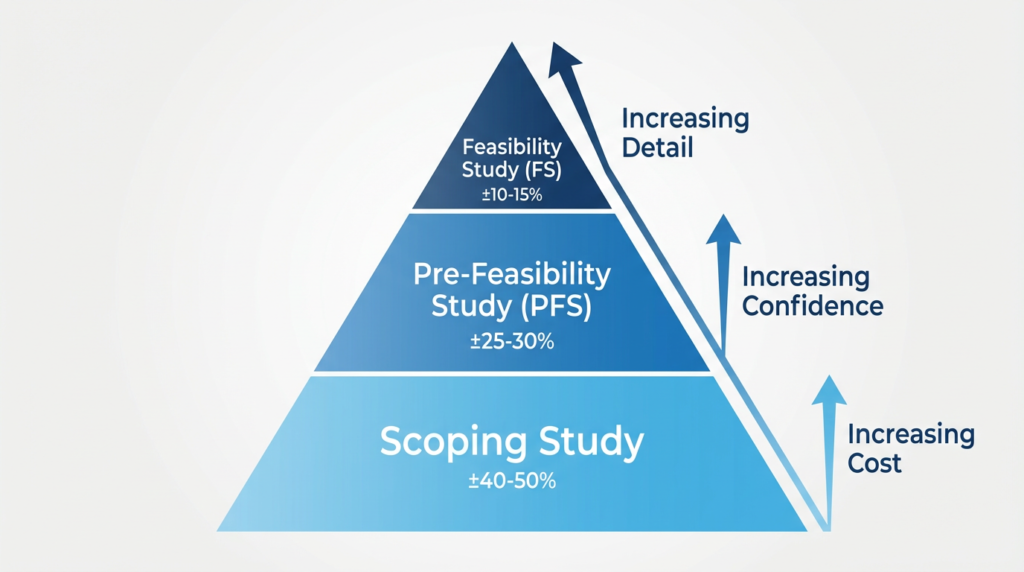
Three study levels are recognized: Scoping Study (Studi Pelingkupan) as an order of magnitude study mentioned for Measured resources [11], [27]; Pre-Feasibility Study (Prastudi Kelayakan) as the minimum requirement for reserve estimation with comprehensive study of modifying factors [13], [27]; and Feasibility Study (Studi Kelayakan) providing more detailed and accurate analysis of geological, technical, and economic factors [27].
JORC 2012:
Three study levels are defined: Scoping Study as an order of magnitude technical and economic study that cannot be used for reserve estimation [40]; Pre-Feasibility Study as the minimum requirement for reserve conversion with comprehensive study and preferred mining method established [39]; and Feasibility Study providing higher confidence level than Pre-Feasibility with detailed technical and economic analysis [39].
Comparative Analysis:
Both codes recognize the same three study levels with similar definitions. A critical difference exists regarding Scoping Studies: JORC explicitly prohibits using Scoping Studies for reserve estimation, while SNI associates Scoping Study level with Measured resources but requires Pre-Feasibility minimum for reserves. Both codes agree that Pre-Feasibility Study is the minimum acceptable level for reserve estimation [11], [27], [13], [40], [39].
8.2 Minimum Study Requirements for Reserves
Both codes require a minimum of Pre-Feasibility Study level for conversion of Mineral Resources to Mineral/Ore Reserves. This study level must include comprehensive assessment of all modifying factors and demonstrate technical feasibility and economic viability [13], [27], [39].
The alignment on Pre-Feasibility Study as the minimum threshold ensures consistent standards for reserve declaration across both jurisdictions, providing comparable confidence levels for investment decisions [13], [39].
9. Modifying Factors Analysis
9.1 Comprehensive Factor Lists
SNI 4726-2019 Modifying Factors:
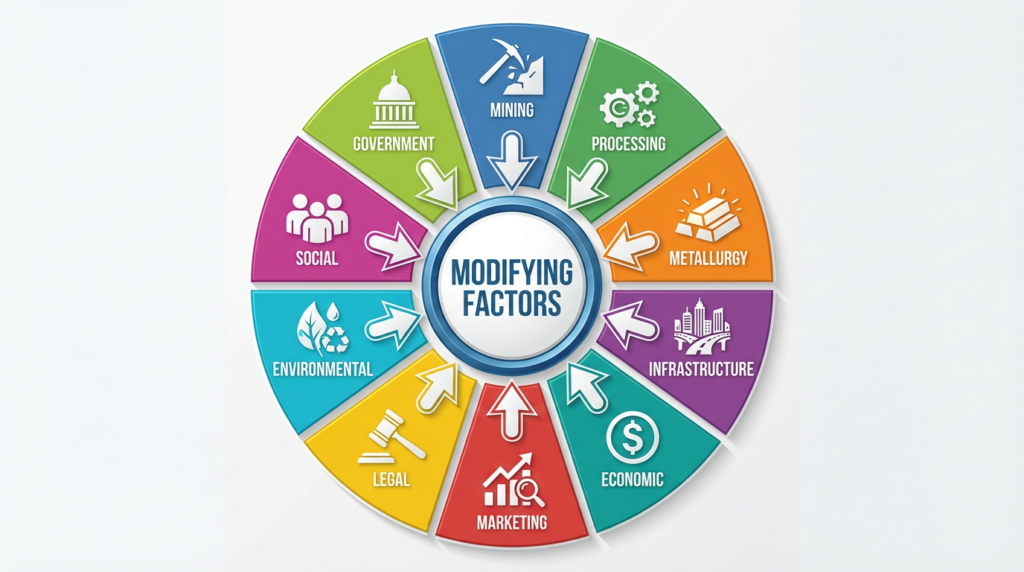
The code requires comprehensive consideration of: technical mining parameters [13]; processing and metallurgy [13], [38]; infrastructure [13], [39]; economic factors [13], [36]; marketing [13]; legal aspects [13], [42]; environmental considerations [13], [42]; social factors [13], [43]; and regulatory/government regulations [13], [40].
JORC 2012 Modifying Factors:
JORC specifies that Modifying Factors include (but are not restricted to): mining [26]; processing [26]; metallurgical [26]; infrastructure [26]; economic [26]; marketing [26]; legal [26]; environmental [26]; social [26]; and governmental [26].
Comparative Analysis:
Both codes require consideration of identical comprehensive modifying factors. The lists are functionally equivalent, covering all technical, economic, legal, environmental, social, and governmental aspects necessary for reserve estimation. JORC’s phrasing “not restricted to” provides flexibility for additional factors as appropriate, while SNI’s list is similarly comprehensive. This alignment ensures consistent consideration of all material factors affecting economic viability [13], [38], [39], [36], [42], [43], [40], [26].
9.2 Economic and Financial Assessment
SNI 4726-2019:
Economic analysis must be performed using discounted cash flow or other reasonable methods [36]. For non-operating mines, pricing assumptions must use reasonable approaches based on product quality, sales point location, and reference to common indices (e.g., LME) [40]. For operating mines, existing sales contracts may be used as basis [40]. Government policies on processing/refining and regulations must be considered [40].
JORC 2012:
NPV (Net Present Value) analysis is required with source and confidence of economic inputs including inflation and discount rate [37]. NPV ranges and sensitivity to significant assumptions must be provided [37]. Revenue factors include head grade, commodity prices, exchange rates, transportation/treatment charges, penalties, and royalties [37]. Market assessment must cover demand/supply, consumption trends, customer/competitor analysis, and market windows [37].
Comparative Analysis:
Both codes require comprehensive economic analysis. JORC explicitly requires NPV analysis and sensitivity testing, while SNI mentions discounted cash flow as one acceptable method. JORC provides more detailed requirements for market assessment and sensitivity analysis. SNI emphasizes consideration of Indonesian government policies on processing and refining. Both ensure rigorous economic evaluation, with JORC providing more prescriptive guidance on specific analytical requirements [36], [40], [37].
9.3 Environmental and Social Considerations
SNI 4726-2019:
Environmental aspects and related permits must be discussed [42]. Environmental permits from government are required and must cover the assumed production level [42]. Social factors and government programs must be evaluated [43]. Community development programs (PPM) and synergy with government programs are required [43].
JORC 2012:
Requirements include status of studies on potential environmental impacts [37]; waste rock characterization and potential site considerations [37]; status of approvals for process residue storage and waste dumps [37]; social license to operate with status of agreements with key stakeholders [37]; and infrastructure availability including land, power, water, transportation, labor, and accommodation [37].
Comparative Analysis:
Both codes require comprehensive environmental and social assessment. SNI emphasizes Indonesian-specific requirements including government permits and community development programs aligned with government initiatives. JORC emphasizes the “social license to operate” concept and stakeholder agreements. Both ensure adequate consideration of environmental impacts and social factors, adapted to their respective regulatory contexts [42], [43], [37].
9.4 Legal and Regulatory Framework
SNI 4726-2019:
Legal aspects include mining operation permits (KK or IUP/IUPK) covering mine life duration [42]; forest area borrowing permit (IPPKH) for exploitation in forest areas [42]; road construction/use permits [42]; and port construction/use permits [42].
JORC 2012:
Legal considerations include mineral tenement status [38]; status of material legal agreements and marketing arrangements [38]; government approvals critical to project viability [38]; reasonable grounds to expect approvals within Pre-Feasibility/Feasibility timeframes [38]; and materiality of unresolved third-party dependent matters [38].
Comparative Analysis:
Both codes require comprehensive legal and regulatory assessment. SNI specifies Indonesian-specific permits (KK, IUP/IUPK, IPPKH) reflecting the Indonesian regulatory framework. JORC uses general terminology applicable to Australian and international contexts, emphasizing tenement status and approval timelines. Both ensure adequate consideration of legal requirements for project viability, adapted to their respective jurisdictions [42], [38].
10. Structured Mapping Tables
10.1 Classification System Crosswalk
| Confidence Level | SNI 4726-2019 (Indonesian) | JORC 2012 (English) | Conversion Pathway |
|---|---|---|---|
| Exploration Stage | Hasil Eksplorasi | Exploration Results | Not resources/reserves |
| Low Confidence Resource | Sumber Daya Mineral Tereka | Inferred Mineral Resource | Cannot convert to reserves |
| Medium Confidence Resource | Sumber Daya Mineral Tertunjuk | Indicated Mineral Resource | → Probable Reserve only |
| High Confidence Resource | Sumber Daya Mineral Terukur | Measured Mineral Resource | → Proved or Probable Reserve |
| Lower Confidence Reserve | Cadangan Mineral Terkira | Probable Ore Reserve | From Indicated (sometimes Measured) |
| Higher Confidence Reserve | Cadangan Mineral Terbukti | Proved Ore Reserve | From Measured only |
10.2 Study Level Requirements Crosswalk
| Study Type | SNI 4726-2019 | JORC 2012 | Application for Reserves |
|---|---|---|---|
| Scoping Study | Studi Pelingkupan | Scoping Study | SNI: Associated with Measured resources; JORC: Cannot estimate reserves |
| Pre-Feasibility Study | Prastudi Kelayakan (Pre-FS) | Pre-Feasibility Study | Minimum for reserve estimation (both codes) |
| Feasibility Study | Studi Kelayakan | Feasibility Study | Higher confidence reserve estimation (both codes) |
10.3 Competent Person Terminology Crosswalk
| Aspect | SNI 4726-2019 | JORC 2012 |
|---|---|---|
| Title | Orang yang Berkompeten | Competent Person |
| Minimum Experience | 5 years relevant experience | 5 years relevant experience |
| Credential | Sertifikat Kompetensi (per Indonesian regulations) | Member/Fellow of AusIMM, AIG, or RPO |
| Professional Discipline | Tenaga Teknis Pertambangan yang Berkompeten | Minerals industry professional |
| Ethics Requirement | Bound by professional rules and code of ethics | Subject to enforceable professional code of ethics |
| Site Visit | Mandatory for reserve reports | Required with outcome commentary; explanation if not undertaken |
| Accountability | Must sign and be accountable for report content | Must provide prior written consent for report |
10.4 Technical Parameter Crosswalk
| Parameter | SNI 4726-2019 Term | JORC 2012 Term |
|---|---|---|
| Dilution | Dilusi | Dilution / Diluting materials |
| Mining losses | Kehilangan penambangan | Losses / Allowances for losses |
| Recovery | Perolehan penambangan / Perolehan proses | Mining recovery / Metallurgical recovery |
| Cut-off grade | Kadar minimum / Parameter cut off | Cut-off grade / Cut-off parameters |
| Modifying factors | Faktor pengubah | Modifying Factors |
| Mineral deposit | Cebakan mineral | Mineral deposit / Mineralization |
| Run of mine | Run of mine (ROM) | Run of mine (ROM) |
| Core recovery | Perolehan inti (≥95% required) | Core recovery (documentation required) |
10.5 Modifying Factors Crosswalk
| Factor Category | SNI 4726-2019 | JORC 2012 | Alignment |
|---|---|---|---|
| Mining | Technical mining parameters | Mining | Identical |
| Processing | Processing and metallurgy | Processing | Identical |
| Metallurgical | Metallurgy | Metallurgical | Identical |
| Infrastructure | Infrastructure | Infrastructure | Identical |
| Economic | Economic factors | Economic | Identical |
| Marketing | Marketing | Marketing | Identical |
| Legal | Legal aspects | Legal | Identical |
| Environmental | Environmental considerations | Environmental | Identical |
| Social | Social factors | Social | Identical |
| Governmental | Regulatory/government regulations | Governmental | Identical |
10.6 Reporting Requirements Crosswalk
| Requirement | SNI 4726-2019 | JORC 2012 | Alignment |
|---|---|---|---|
| Category Specification | Must state Inferred/Indicated/Measured or Probable/Proved | Must state category clearly | Identical |
| Combined Reporting | Cannot combine without individual disclosure | Cannot combine without individual disclosure | Identical |
| Tonnage and Grade | Must report with metal/mineral content | Must report with metal/mineral content | Identical |
| Resource-Reserve Separation | Must report separately | Must report separately | Identical |
| Annual Reporting | Not specified | Required with effective dates | JORC more prescriptive |
| Transparency | Clear, unambiguous, not confusing | Clear, unambiguous, not misleading | Identical principle |
| Materiality | All relevant information for decision-making | All relevant information for reasoned judgment | Identical principle |
11. Key Similarities and Differences
11.1 Structural Alignments
Both codes demonstrate strong structural alignment in fundamental frameworks:
- Identical three-tier resource classification (Inferred/Indicated/Measured) with the same confidence levels and conversion restrictions [6], [4]
- Identical two-tier reserve classification (Probable/Proved) with the same derivation requirements [13], [11]
- Same three foundational principles (Transparency, Materiality, Competence) governing all reporting [1], [2]
- Pre-Feasibility Study minimum requirement for reserve estimation in both codes [13], [39]
- Identical modifying factors requiring comprehensive consideration of technical, economic, legal, environmental, social, and governmental aspects [13], [26]
- Same conversion restrictions: Inferred cannot convert to reserves; Indicated only to Probable; Measured to Proved or Probable [8], [10], [12], [5], [6], [8], [10]
- Identical reporting prohibitions: Cannot combine categories without individual disclosure; cannot report metal content without tonnage and grade [21], [22], [4], [11]
- Same competent person experience requirement: 5 years minimum in relevant activities [23], [21]
11.2 Technical Alignments
The codes share identical technical requirements in key areas:
- Resource definition: Both require “reasonable prospects for eventual economic extraction” as the threshold for resource classification [6], [4]
- Reserve definition: Both define reserves as the “economically mineable part” of Indicated and/or Measured resources [13], [11]
- Geological confidence basis: Both use data quality, density, and reliability as the basis for classification [6], [4]
- Inclusion of dilution and losses: Both require reserves to include diluting materials and allowances for losses [13], [14], [11]
- Modifying factors application: Both require comprehensive assessment of the same set of modifying factors [13], [26]
- Professional ethics requirement: Both require Competent Persons to be subject to enforceable professional codes of ethics [1], [20]
11.3 Key Differences
Despite strong overall alignment, several material differences exist:
11.3.1 Regulatory Context
SNI 4726-2019 operates within the Indonesian regulatory framework, requiring government-recognized competency certification and specific Indonesian permits (KK, IUP/IUPK, IPPKH) [23], [42]. JORC 2012 operates within the Australian/NZ stock exchange compliance framework, requiring professional organization membership (AusIMM, AIG, RPO) and emphasizing ongoing stock exchange disclosure [20], [18].
11.3.2 Reporting Frequency
JORC 2012 explicitly mandates annual public reporting of Mineral Resources and Ore Reserves with nominated review dates and discussion of material changes [18]. SNI 4726-2019 does not specify annual reporting frequency, focusing instead on reporting standards when reports are issued [1].
11.3.3 Scoping Study Application
JORC 2012 explicitly prohibits using Scoping Studies for reserve estimation [40]. SNI 4726-2019 associates Scoping Study level with Measured resource economic assessment but requires Pre-Feasibility minimum for reserves [11], [13]. Both agree on Pre-Feasibility as the minimum for reserves, but differ in their treatment of Scoping Studies.
11.3.4 Level of Prescription
SNI 4726-2019 provides more prescriptive guidance on specific deliverables, particularly for life-of-mine planning (production schedules, equipment requirements, waste material balance, stage design plans) [37] and specific cut-off parameters for various commodity types [33]. JORC 2012 provides more comprehensive checklists through Table 1, covering detailed technical aspects of sampling, drilling, assay quality, and data verification [2], but is more principles-based in its approach to planning deliverables.
11.3.5 Core Recovery Standards
SNI 4726-2019 specifies a precise 95% minimum core recovery threshold, with explanation required if recovery is lower due to geological factors [31]. JORC 2012 requires documentation of recovery methods, measures to maximize recovery, and the relationship between recovery and grade, but does not specify a numerical threshold [30].
11.3.6 Economic Analysis Requirements
JORC 2012 explicitly requires NPV (Net Present Value) analysis with sensitivity testing and detailed specification of economic inputs [37]. SNI 4726-2019 mentions discounted cash flow as one acceptable method among other reasonable approaches [36]. JORC is more prescriptive regarding specific analytical techniques.
11.3.7 Consent and Conflict Disclosure
JORC 2012 places greater emphasis on written consent documentation through Competent Person’s Consent Forms and explicit disclosure of conflicts of interest and relationships with reporting companies [22], [23], [24]. SNI 4726-2019 emphasizes accountability through signing of reports and site visit requirements but is less explicit about consent forms and conflict disclosure procedures [25], [26].
11.3.8 Environmental and Social Emphasis
SNI 4726-2019 emphasizes Indonesian-specific requirements including government environmental permits, community development programs (PPM), and synergy with government social programs [42], [43]. JORC 2012 emphasizes the “social license to operate” concept, stakeholder agreements, and waste rock characterization [37]. Both require comprehensive assessment but with different emphases reflecting their regulatory contexts.
12. Conclusions and Recommendations
12.1 Overall Assessment
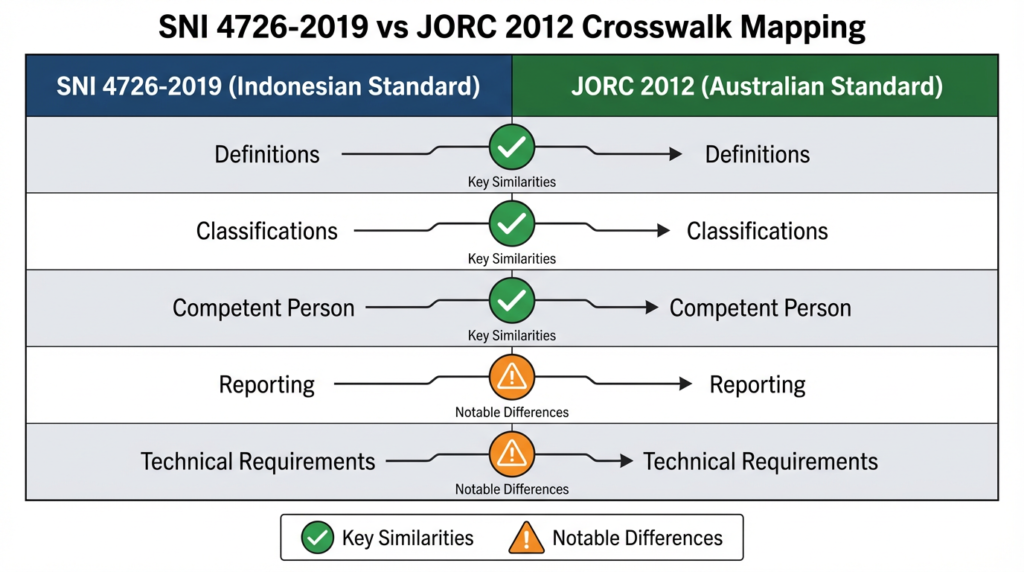
SNI 4726-2019 and JORC 2012 demonstrate substantial harmonization in their fundamental frameworks, definitions, and technical requirements. The codes are functionally equivalent for resource and reserve classification purposes, with differences primarily reflecting jurisdictional contexts, regulatory emphases, and implementation approaches rather than fundamental technical disagreements [1], [2].
12.2 Functional Equivalence
The analysis confirms that:
- Classification systems are identical in structure, definitions, and conversion pathways [6], [4], [13], [11]
- Core principles are the same (Transparency, Materiality, Competence) [1], [2]
- Technical requirements are aligned on fundamental aspects including modifying factors, study levels, and competent person qualifications [13], [26], [23], [21]
- Reporting standards are consistent regarding category specification, tonnage/grade disclosure, and prohibition on combined reporting [21], [22], [4], [11]
12.3 Practical Implications for Cross-Jurisdictional Work
Practitioners working across both Indonesian and Australian/international jurisdictions can:
- Apply the same technical methodologies for resource estimation, geological modeling, and reserve conversion
- Use identical classification logic for categorizing resources and reserves
- Rely on the same fundamental principles for professional conduct and reporting
- Adapt reporting format and emphasis to meet each code’s specific requirements without changing underlying technical work
12.4 Recommendations for Practitioners
12.4.1 For Indonesian Projects Reporting Under SNI
- Ensure Competent Persons hold Indonesian government-recognized competency certificates [23]
- Obtain all required Indonesian permits (KK/IUP/IUPK, IPPKH, environmental permits) [42]
- Maintain core recovery ≥95% or document geological reasons for lower recovery [31]
- Include detailed life-of-mine planning deliverables as specified in SNI [37]
- Address community development programs and government policy alignment [43]
- Conduct mandatory site visits for reserve reports with documented observations [26]
12.4.2 For Australian/International Projects Reporting Under JORC
- Ensure Competent Persons are Members/Fellows of AusIMM, AIG, or recognized RPOs [20]
- Prepare annual public reports with effective dates and material change discussions [18]
- Complete Competent Person’s Consent Forms for all public reports [24]
- Provide comprehensive Table 1 checklist documentation [2]
- Conduct NPV analysis with sensitivity testing for reserve estimates [37]
- Disclose conflicts of interest and Competent Person relationships [22]
- Do not use Scoping Studies for reserve estimation [40]
12.4.3 For Cross-Jurisdictional Reporting
- Recognize that the same technical work can support reporting under both codes
- Adapt reporting format, emphasis, and documentation to meet specific code requirements
- Ensure Competent Persons meet credentialing requirements for the relevant jurisdiction
- Address jurisdiction-specific regulatory requirements (permits, approvals, social programs)
- Maintain documentation sufficient to meet the more comprehensive requirements of both codes
- Consider preparing dual reports when projects require compliance with both codes
12.5 Areas of Harmonization Success
The strong alignment between SNI 4726-2019 and JORC 2012 reflects successful international harmonization efforts in mineral reporting standards. Key areas of harmonization success include:
- Unified classification framework enabling consistent global communication of resource and reserve confidence levels
- Common technical language facilitating international investment and project evaluation
- Shared professional standards for competent person qualifications and ethics
- Consistent reporting principles supporting transparent and material disclosure
12.6 Future Considerations
As both codes evolve through future revisions, continued alignment on core technical standards while respecting jurisdictional differences will support:
- International investment flows through comparable and credible reporting
- Professional mobility of qualified practitioners across jurisdictions
- Technology transfer and best practice sharing
- Regulatory efficiency through mutual recognition of equivalent standards
The existing strong alignment between SNI 4726-2019 and JORC 2012 provides a solid foundation for continued harmonization while preserving appropriate adaptation to local regulatory contexts and operational requirements [1], [2].
References
[1] SNI 4726-2019, Indonesian National Standard for Reporting Exploration Results, Mineral Resources, and Mineral Reserves
[2] JORC Code, 2012 Edition, Australasian Code for Reporting of Exploration Results, Mineral Resources and Ore Reserves
[3] SNI 4726-2019, Definition of Exploration Results
[4] SNI 4726-2019, Exploration Results Reporting Requirements
[5] JORC 2012, Inferred Mineral Resource Definition
[6] SNI 4726-2019, Mineral Resource Definition and Classification
[7] SNI 4726-2019, Inferred Mineral Resource (Tereka) Definition
[8] SNI 4726-2019, Inferred Resource Conversion Restrictions
[9] SNI 4726-2019, Indicated Mineral Resource (Tertunjuk) Definition
[10] SNI 4726-2019, Indicated Resource Characteristics and Conversion
[11] SNI 4726-2019, Measured Mineral Resource (Terukur) Definition
[12] SNI 4726-2019, Measured Resource Conversion Pathways
[13] SNI 4726-2019, Mineral Reserve Definition and Requirements
[14] SNI 4726-2019, Reserve Modifying Factors
[15] SNI 4726-2019, Probable Mineral Reserve (Terkira) Definition
[16] SNI 4726-2019, Probable Reserve Confidence Level
[17] SNI 4726-2019, Proved Mineral Reserve (Terbukti) Definition
[18] SNI 4726-2019, Proved Reserve Requirements
[19] SNI 4726-2019, Proved Reserve Confidence Level
[20] SNI 4726-2019, Exploration Results Reporting Standards
[21] SNI 4726-2019, Mineral Resource Reporting Requirements
[22] SNI 4726-2019, Mineral Reserve Reporting Requirements
[23] SNI 4726-2019, Competent Person Qualifications
[24] SNI 4726-2019, Competent Person Verification Responsibilities
[25] SNI 4726-2019, Competent Person Accountability
[26] SNI 4726-2019, Site Visit Requirements
[27] SNI 4726-2019, Study Level Definitions
[28] SNI 4726-2019, Feasibility Study Requirements
[29] SNI 4726-2019, Statistical Analysis Requirements
[30] SNI 4726-2019, Geostatistical Analysis
[31] SNI 4726-2019, Core Recovery and Sampling Requirements
[32] SNI 4726-2019, Geological Validation Methods
[33] SNI 4726-2019, Cut-off Parameters
[34] SNI 4726-2019, Mining Parameters
[35] SNI 4726-2019, Geotechnical and Hydrogeological Requirements
[36] SNI 4726-2019, Economic Analysis Requirements
[37] SNI 4726-2019, Life-of-Mine Planning Requirements
[38] SNI 4726-2019, Processing and Metallurgy Requirements
[39] SNI 4726-2019, Infrastructure Requirements
[40] SNI 4726-2019, Market and Pricing Assumptions
[41] SNI 4726-2019, Government Regulations Consideration
[42] SNI 4726-2019, Legal and Environmental Requirements
[43] SNI 4726-2019, Social Factors and Community Programs
[1] JORC 2012, Principles of Transparency, Materiality, and Competence
[2] JORC 2012, Exploration Results Definition and Reporting
[3] JORC 2012, Exploration Results Examples
[4] JORC 2012, Mineral Resource Definition
[5] JORC 2012, Inferred Mineral Resource Classification
[6] JORC 2012, Inferred Resource Upgrade Expectations
[7] JORC 2012, Indicated Mineral Resource Definition
[8] JORC 2012, Indicated Resource Conversion Restrictions
[9] JORC 2012, Measured Mineral Resource Definition
[10] JORC 2012, Measured Resource Conversion Pathways
[11] JORC 2012, Ore Reserve Definition
[12] JORC 2012, Probable Ore Reserve Definition
[13] JORC 2012, Proved Ore Reserve Definition
[14] JORC 2012, Transparency Requirements
[15] JORC 2012, Materiality Requirements
[16] JORC 2012, Competence Requirements
[17] JORC 2012, Scope of Application
[18] JORC 2012, Annual Review Requirements
[19] JORC 2012, Exploration Targets Reporting
[20] JORC 2012, Competent Person Definition and Membership
[21] JORC 2012, Competent Person Experience Requirements
[22] JORC 2012, Competent Person Consent and Disclosure
[23] JORC 2012, Written Consent Requirements
[24] JORC 2012, Consent Form Recommendations
[25] JORC 2012, Geological Confidence and Data Quality
[26] JORC 2012, Modifying Factors Definition
[27] JORC 2012, Data Density Requirements
[28] JORC 2012, Rounding Conventions
[29] JORC 2012, Table 1 Checklist
[30] JORC 2012, Sampling and Data Quality (Table 1 Section 1)
[31] JORC 2012, Sample Recovery Documentation
[32] JORC 2012, Exploration Results Reporting Criteria (Table 1 Section 2)
[33] JORC 2012, Mineral Resource Estimation Criteria (Table 1 Section 3)
[34] JORC 2012, Estimation Techniques
[35] JORC 2012, Block Size and Selective Mining Units
[36] JORC 2012, Ore Reserve Estimation Criteria (Table 1 Section 4)
[37] JORC 2012, Economic Analysis and NPV Requirements
[38] JORC 2012, Legal Considerations
[39] JORC 2012, Pre-Feasibility Study Requirements
[40] JORC 2012, Scoping Study Limitations


