

Open‑pit mine planning ultimately aims to maximize Net Present Value (NPV) while satisfying geotechnical, operational, environmental and market constraints. To manage this complexity, most mines decompose the problem into three main stages:
- Geological and economic modelling – build a 3D block model and assign economic values.
- Pit limit and phase (pushback) optimization – decide what part of the deposit to mine, and in what broad order.
- Time‑phased production scheduling – decide when to mine each part, at what rate, and to which destination.
Commercially, a very powerful way to implement this decomposition is the Surpac → Whittle → MineSched chain:
- Surpac: geological and economic block modelling; first “technical” pit view.
- Whittle: rigorous economic pit optimization and pushback design.
- MineSched: detailed life‑of‑mine and short‑term production scheduling.
This mirrors the structure assumed in advanced optimization research on long‑ and short‑term planning (Fathollahzadeh et al., 2021; Malundamene et al., 2024; Osanloo, Gholamnejad and Karimi, 2008; Blom, Pearce and Stuckey, 2019).
Surpac: From Exploration Data to Economic Block Model
Data management and geological framework
Surpac is used to convert exploration and survey data into a consistent geological model:
- Drillhole collars, downhole surveys, assays and lithology logs are validated and composited.
- Wireframes/solids delineate ore zones, waste domains, oxidation/weathering boundaries and major structures.
- Topographic surfaces and existing pit surfaces constrain the data in three dimensions.
This step addresses geo‑environmental factors in the sense that the geometry, rock types and weathering zones strongly influence operational factors such as machine productivity, haul distances and ore recovery (Mishra, Panigrahi and Shrivastava, 2023).
Block model construction
Within the geological solids, a 3D grid of blocks is defined (e.g., 10–25 m in X/Y, one bench in Z):
- Each block stores coordinates, rock/alteration code, density and other attributes.
- Block size is chosen as a trade‑off between geological resolution and computational complexity; smaller blocks better represent ore–waste contacts but create much larger optimization problems (Fathollahzadeh et al., 2021; Osanloo, Gholamnejad and Karimi, 2008).
Grade estimation and resource quantification
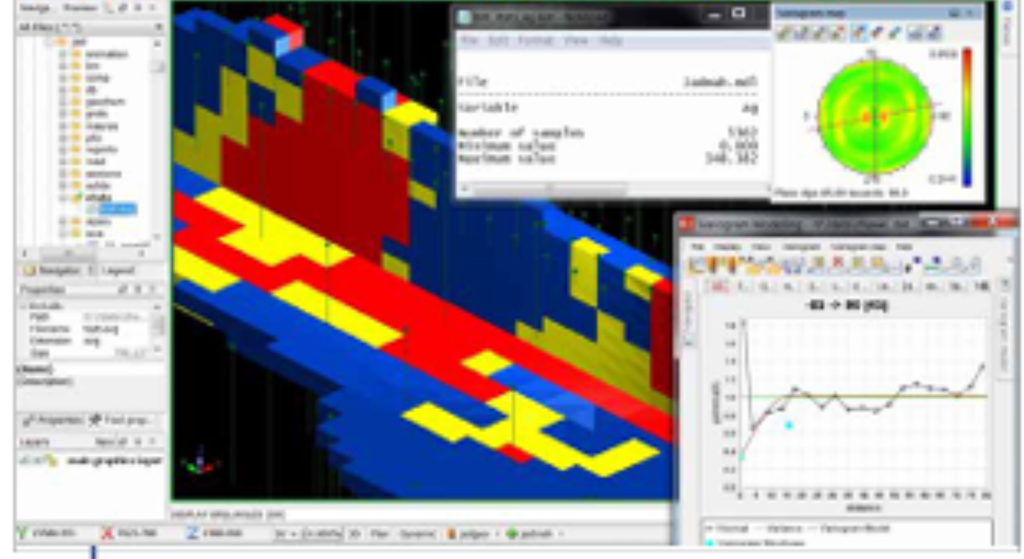
Grades for key elements are estimated via methods such as inverse distance weighting, ordinary kriging or other geostatistics:
- The result is a block grade model from which in‑situ resources and grade‑tonnage curves are computed.
- Accurate grade models are essential because all downstream optimization (pit limits, scheduling) aims to maximize NPV based on these grades (Fathollahzadeh et al., 2021; Osanloo, Gholamnejad and Karimi, 2008).
Economic block valuation
Surpac then assigns basic economics to each block:
- Mining cost per tonne (varies by depth, rock type, or area).
- Processing cost and metallurgical recovery, possibly by ore type or geometallurgical domain.
- Selling price, smelting and refining charges, penalties for impurities, royalties, etc.
A simple form of block value (Vi) is:
[ Vi = p x Ri x gi x ti – (C(m,i) + C(p,i)) x ti]
where (p) is commodity price, (Ri) is recovery, (gi) is grade, (ti) is tonnage, and C(m,i), C(p,i) are mining and processing costs. This converts geology into economic information, enabling optimization.
First “technical pit” estimate in Surpac
Many operations run Surpac’s optimized‑pit or similar tools as a first technical check:
- Slope geometries, basic costs and prices are input.
- Surpac returns a set of pits that are geometrically feasible and roughly economic.
This is not yet the ultimate economic answer, but it:
- Screens out clearly uneconomic parts of the deposit.
- Calibrates slope sectors and block size.
- Provides a starting point for detailed economic optimization in Whittle.
Whittle: Economic Pit Optimization and Phase Design
Whittle is purpose‑built for ultimate pit and phase optimization.
Lerchs–Grossmann and related algorithms
Whittle implements the Lerchs–Grossmann (LG) algorithm and variants to solve the open‑pit limit problem:
- Represent each block as a node with weight (Vi) (its economic value).
- Add precedence arcs representing slope constraints: a block is only mineable if all required overlying blocks are mined.
- The problem is: find the subset of nodes (the pit) satisfying all precedences with maximum total value (Fathollahzadeh et al., 2021; Osanloo, Gholamnejad and Karimi, 2008).
These algorithms are core to modern deterministic long‑term pit optimization (Fathollahzadeh et al., 2021; Osanloo, Gholamnejad and Karimi, 2008). The resulting ultimate pit is the largest economically justifiable excavation under the given assumptions.
Nested pits via revenue factors
Because economics may change, Whittle generates nested pit shells using revenue factors (RF):
- RF multiplies revenue (p x R x g) while leaving costs constant.
- RF < 1 simulates lower prices or worse economics; only high‑margin core ore remains economic.
- RF = 1 corresponds to base‑case.
- RF > 1 explores more optimistic cases.
The shells at different RF values are nested; together they form a family of pits. This allows a detailed sensitivity analysis to price/cost assumptions:
- Researchers emphasize that planning should consider price risk and uncertainty; NPV can vary significantly with RF (Fathollahzadeh et al., 2021; Osanloo, Gholamnejad and Karimi, 2008).
- Selecting too large a pit for current price can increase stripping cost, equipment hours, and haulage distances, raising operating cost per unit metal (Das, Topal and Mardaneh, 2023).

Techno‑economic selection of optimal project
For each shell, basic long‑term cash flows can be simulated (e.g by bench‑averaged production profiles), providing:
- Total undiscounted profit, NPV at different discount rates, life‑of‑mine, strip ratio.
- Key KPIs such as ore tonnage above plant cut‑off and metal production.
By comparing pits across RFs, planners can choose a pit that:
- Maximizes NPV, not just undiscounted value.
- Avoids over‑stripping, which would raise operational cost and delay high‑grade exposure.
Reviews of long‑term planning methodologies show that NPV‑driven pit limits are essential for economic viability; suboptimal pit limits can make a project marginal or uneconomic (Fathollahzadeh et al., 2021; Osanloo, Gholamnejad and Karimi, 2008).
Pushback (phase) design and the “gap problem”
Real pits are mined in pushbacks (phases):
- Pushbacks are designed from nested shells to create workable mining fronts with minimum width and reasonable bench access.
- They determine how stripping and ore exposure are sequenced in time, directly affecting capital deployment and operating costs.
Research shows that naive pushback selection can create gap problems—large jumps in size between phases that leave unmined “gaps” of high‑value blocks or create phases that are too big or too small, degrading NPV (Meagher, Dimitrakopoulos and Avis, 2014):
- Gap problems often lead to excessive early stripping or delayed access to ore, both of which raise unit cost and reduce cash flow (Meagher, Dimitrakopoulos and Avis, 2014).
- Improved methods incorporate discounting and pushback size constraints at design stage to enhance NPV (Meagher, Dimitrakopoulos and Avis, 2014).
Whittle’s tools (e.g., Milawa strategies) help professionals design and sequence pushbacks to:
- Bring forward high‑value ore.
- Avoid long periods of high stripping with low revenue.
- Smooth out waste mining and plant feed.
Export to Surpac for detailed pit and ramp design
Once ultimate pit and pushbacks are chosen, Whittle shells are exported back to Surpac for:
- Detailed geometric design: benches, berms, inter‑ramp and overall slopes.
- Haul road and ramp design following company standards and equipment requirements.
- Volume and tonnage calculations per bench, phase and material type.
At this stage, planners have an economically optimized pit layout and an operationally feasible geometry.
MineSched: Time‑Phased Production Scheduling
The final strategic step is to turn pit and phase designs into a time‑phased schedule that achieves production and cost objectives.
The production scheduling problem
Conceptually, MineSched solves the open‑pit production scheduling problem (OPPS):
- Decide, for each block or mining unit and each time period, whether and when it will be mined and where its material will go.
- Objective: typically maximize NPV of cash flows, or sometimes minimize cost while meeting a target NPV or production profile (Fathollahzadeh et al., 2021; Osanloo, Gholamnejad and Karimi, 2008; Blom, Pearce and Stuckey, 2019).
- Constraints:
- Precedence (slope) constraints between blocks or mining cuts.
- Mining capacity (equipment limits, drill/blast limits).
- Processing capacity and blending (grade and impurity constraints).
- Waste dump and stockpile capacity, sometimes environmental constraints (Fathollahzadeh et al., 2021; Das, Topal and Mardaneh, 2023; Malundamene et al., 2024; Blom, Pearce and Stuckey, 2019).
The OPPS is NP‑hard and has attracted substantial research in exact (mixed‑integer programming) and heuristic/meta‑heuristic solution strategies (Fathollahzadeh et al., 2021; Malundamene et al., 2024; Blom, Pearce and Stuckey, 2019). Commercial tools like MineSched embed practical versions of these ideas.

Constraints and objective in practice
In MineSched, formulation typically includes:
- Mining capacity constraints
- Total mined tonnes (ore + waste) per period must lie within equipment limits.
- Proper scheduling prevents over‑utilization or under‑utilization of trucks and shovels, which research links to improved machine productivity and lower unit costs (Mishra, Panigrahi and Shrivastava, 2023; Malundamene et al., 2024; Voronov, Dubinkin and Voronov, 2023).
- Processing and blending constraints
- Plant feed tonnage per period must be within capacity.
- Average feed grade and key impurity/quality variables must satisfy bands to ensure stable metallurgy and product quality (Das, Topal and Mardaneh, 2023; Malundamene et al., 2024; Blom, Pearce and Stuckey, 2019).
- Good scheduling of ore feed quality reduces corrective actions at the plant and supports cost‑effective beneficiation (Das, Topal and Mardaneh, 2023).
- Precedence and slope constraints
- Mining units must obey vertical and horizontal precedences derived from pit geometry.
- Bench leads and active face limits are specified so that schedules remain operationally feasible, especially on the short term (Malundamene et al., 2024; Blom, Pearce and Stuckey, 2019).
- Destination decisions (plant vs. stockpile vs. waste)
- High‑grade ore may go directly to plant; marginal ore to stockpile.
- Waste is sent to specific dumps; in more advanced models, waste movement and placement are explicitly costed (Das, Topal and Mardaneh, 2023).
The objective function typically discounts future cash flows with a rate (r):
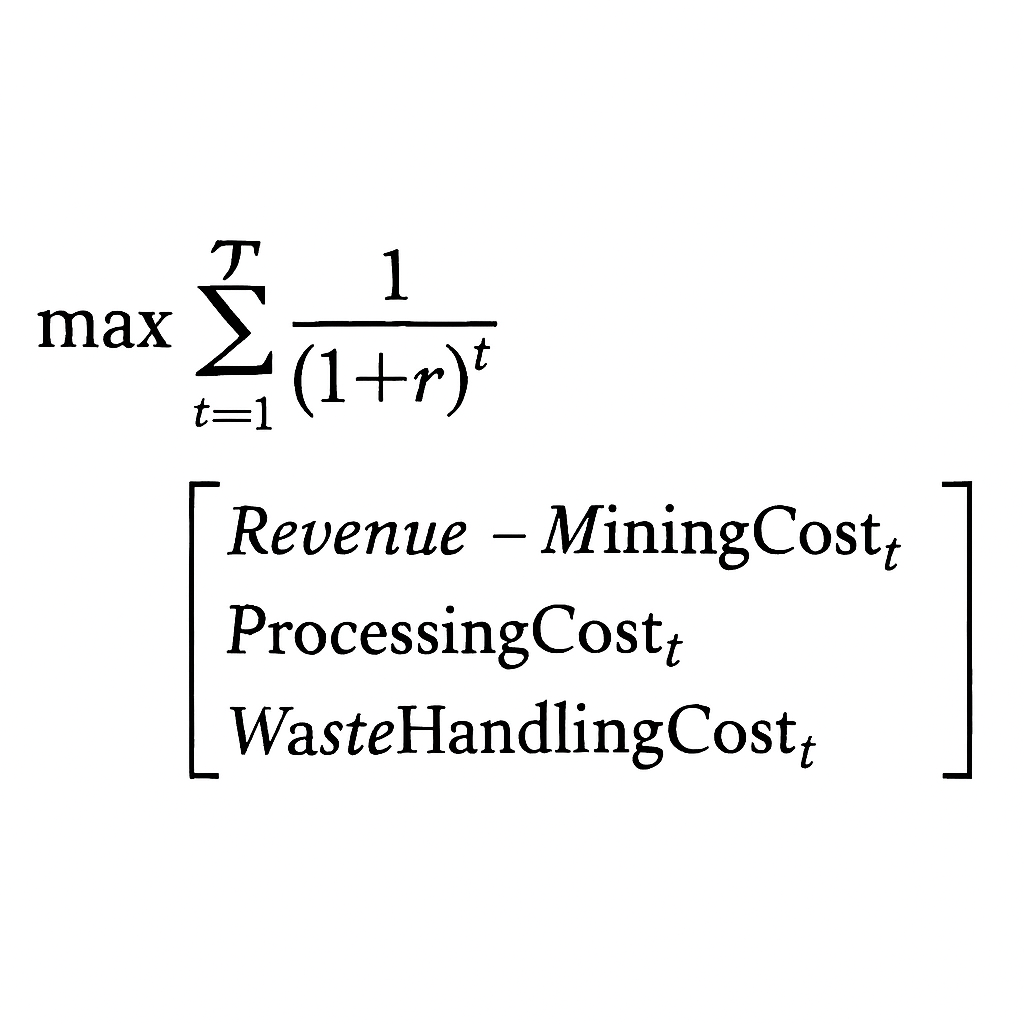
Properly formulated schedules can significantly improve NPV and reduce cost relative to ad‑hoc or purely heuristic plans (Fathollahzadeh et al., 2021; Malundamene et al., 2024; Blom, Pearce and Stuckey, 2019).
Link to operational cost and equipment optimization
Operational cost in open‑pit mines is heavily influenced by:
- Transportation cost, which can be 50–60% of total mining operating cost (Mishra, Panigrahi and Shrivastava, 2023).
- Equipment optimization, including fleet size, dispatching and utilization (Mishra, Panigrahi and Shrivastava, 2023; Malundamene et al., 2024; Voronov, Dubinkin and Voronov, 2023).
- Production sequencing and resource allocation (Mishra, Panigrahi and Shrivastava, 2023).
MineSched contributes to cost savings by:
- Choosing sequences that minimize unnecessary haulage of waste while meeting pit and phase objectives, echoing themes in waste dump scheduling research (Das, Topal and Mardaneh, 2023).
- Smoothing production and avoiding large deviations from the long‑term plan, which reduces frequent re‑deployment of equipment and associated inefficiencies (Malundamene et al., 2024; Blom, Pearce and Stuckey, 2019).
- Providing a clear, optimized sequence of cuts and benches, which interacts with fleet dispatch and modular dispatch systems that can cut fleet requirements by up to 30% when properly implemented (Mishra, Panigrahi and Shrivastava, 2023; Voronov, Dubinkin and Voronov, 2023).
A state‑of‑the‑art review of short‑term planning emphasizes that high‑quality short‑term schedules aligned with long‑term plans are central to lowering drilling, blasting and extraction costs and improving utilization of shovels and trucks (Malundamene et al., 2024).
How the Integrated Workflow Reduces Operating Cost and Delivers Objectives
1. Better pit limits → less waste movement per tonne of metal
By using Whittle’s LG‑based optimization on a realistic Surpac economic block model, the operation:
- Avoids over‑large pits imposed by a “maximum ore volume” mentality.
- Limits stripping to economically justified material.
Since waste movement is both a major operating cost and a key part of environmental liabilities, better pit limits directly reduce total waste tonnes, lowering fuel, tire, maintenance and dump construction costs (Mishra, Panigrahi and Shrivastava, 2023; Das, Topal and Mardaneh, 2023). Recent reviews highlight the growing role of waste movement and placement in pit scheduling, noting that its inclusion leads to more cost‑effective and environmentally compliant plans (Das, Topal and Mardaneh, 2023).
2. Pushbacks that smooth stripping and accelerate cash flow
Good pushback design using Whittle and later refined in Surpac:
- Accelerates access to higher‑grade zones, improving early cash flows and NPV (Fathollahzadeh et al., 2021; Meagher, Dimitrakopoulos and Avis, 2014; Osanloo, Gholamnejad and Karimi, 2008).
- Avoids long periods of high waste stripping with little revenue.
- Creates more even mining depths and shorter average haul distances at a given time.
Smoother stripping and optimized pushbacks reduce:
- Peak fleet requirements and hence capital intensity (fewer trucks/shovels required at maximum).
- Idle times due to uneven material availability.
Research on pushback design emphasizes that designs addressing the gap problem (controlling the size and sequence of pushbacks while accounting for discounting) deliver higher NPV than naive or purely manual designs (Meagher, Dimitrakopoulos and Avis, 2014).
3. Schedules that stabilize production and ore quality
MineSched turns pushbacks into executable schedules that:
- Maintain target ore tonnage to the plant with limited variability.
- Keep feed grades and impurities within controlled bands, reducing plant upset conditions (Das, Topal and Mardaneh, 2023; Malundamene et al., 2024; Blom, Pearce and Stuckey, 2019).
- Enforce mining capacity and bench‑lead constraints to ensure that the plan is operationally executable (Malundamene et al., 2024; Blom, Pearce and Stuckey, 2019).
Short‑term planning research underscores that detailed, optimized plans with appropriate clustering of mining cuts reduce daily and weekly deviations, which improves:
- Fleet utilization and reduces unit cost of drilling, blasting and hauling (Malundamene et al., 2024).
- Energy use and wear on equipment due to fewer unscheduled re‑allocations.
Managerial and operational studies also note that better production scheduling optimization and resource allocation are central elements of operational performance, linked to improved machine productivity and lower operational factors such as transportation inefficiency (Mishra, Panigrahi and Shrivastava, 2023).
4. Support for dispatch and real‑time optimization
Even though Surpac, Whittle and MineSched are strategic/tactical tools, their outputs interact directly with:
- Truck and shovel dispatch systems, which then determine exact truck routing in real time (Mishra, Panigrahi and Shrivastava, 2023; Voronov, Dubinkin and Voronov, 2023).
- Simulation and optimization frameworks that refine shovel movement and fleet allocation to match the planned production (Malundamene et al., 2024; Voronov, Dubinkin and Voronov, 2023).
Studies of dispatch systems show that aligning medium‑term plans with dispatch rules and using mathematical programming to support equipment assignment improves productivity and reduces the need for fully automated systems while maintaining much of their benefit (Voronov, Dubinkin and Voronov, 2023). Since transportation is 50–60% of mining operating cost (Mishra, Panigrahi and Shrivastava, 2023), even modest gains in haul efficiency translate to large cost reductions.
5. Managerial factors and operational performance
A recent study of geo‑environmental, managerial and operational factors in Indian open‑pit mines highlights:
- Production scheduling optimization, resource allocation, transportation and equipment optimization as core operational drivers (Mishra, Panigrahi and Shrivastava, 2023).
- Managerial factors (such as planning quality and decision support) partially mediate the impact of geo‑environmental conditions on operational performance (Mishra, Panigrahi and Shrivastava, 2023).
The Surpac → Whittle → MineSched workflow is, in essence, an advanced managerial toolset for:
- Structuring resource allocation (where and when to mine).
- Optimizing production sequencing (in what order to mine benches and pushbacks).
- Providing clear operational targets for fleet and plant.
Thus, it operationalizes the managerial improvements that are empirically associated with better operational outcomes in large mines (Mishra, Panigrahi and Shrivastava, 2023).
Illustrative Case‑Style Scenario: Cost Saving Logic
While no published paper gives a full Surpac–Whittle–MineSched case with numerical before/after cost data, combining results from scheduling and operational research allows a plausible scenario:
- Before integration
- Manual pit design based mainly on maximum ore volume.
- Ad‑hoc phase boundaries; limited NPV analysis.
- Monthly schedules built in spreadsheets, often violating capacity or grade constraints.
- Fleet dispatch reacts to frequent shortfalls and changes, causing high idle times and long queues.
- After Surpac → Whittle → MineSched integration
- Whittle‑optimized pit reduces waste/ore ratio by, say, 5–10% relative to manual design, lowering waste haulage by millions of tonnes over LOM.
- Pushbacks designed to bring forward higher‑grade ore improve early cash flows and NPV, as suggested by discounting‑aware pushback methods (Meagher, Dimitrakopoulos and Avis, 2014).
- MineSched‑based schedules better align mining and processing: reduced grade variability, fewer plant disruptions, and improved recovery (Das, Topal and Mardaneh, 2023; Malundamene et al., 2024).
- Plans support efficient dispatching and fleet management, reducing truck fleet requirements. Literature on fleet management shows that modern dispatch and optimized routing can reduce required fleet size by up to ~30% in some contexts when integrated with good plans (Mishra, Panigrahi and Shrivastava, 2023; Voronov, Dubinkin and Voronov, 2023).
Given that transportation alone is 50–60% of operating cost (Mishra, Panigrahi and Shrivastava, 2023), and that drilling/blasting/extraction costs are also sensitive to scheduling quality (Malundamene et al., 2024), the combined effect can be substantial in practice, even though the exact percentage will depend on local conditions.
How to Present This Workflow to Mine Planning Engineer
To make this powerful but technical workflow easy to understand:
- Frame it around three big questions
- Use a flow diagram of data
- Exploration data → Surpac block model + values → Whittle pit + pushbacks → Surpac detailed design → MineSched schedule.
- Connect each step to cost and objectives
- Show how better pit limits reduce waste haulage.
- Explain how good pushbacks control stripping and improve cash flow.
- Show how MineSched schedules stabilize production and feed quality, enabling efficient equipment use and lower unit costs.
- Reference supporting concepts from literature
- NPV‑maximizing long‑term production planning (Fathollahzadeh et al., 2021; Osanloo, Gholamnejad and Karimi, 2008).
- Waste movement and placement in scheduling (Das, Topal and Mardaneh, 2023).
- Short‑term planning’s role in cost and equipment efficiency (Malundamene et al., 2024; Blom, Pearce and Stuckey, 2019).
- Managerial and operational factors—scheduling, transportation, equipment optimization—driving operational performance (Mishra, Panigrahi and Shrivastava, 2023; Voronov, Dubinkin and Voronov, 2023).
Summary Table: Workflow and Cost‑Saving Mechanisms
| Stage | Main Function | Key Cost / Objective Impact |
|---|---|---|
| Surpac | Geological + economic block model; first technical pit | Accurate resource base; avoids mis‑valuation and over‑design |
| Whittle | LG‑based pit and pushback optimization | Reduces unnecessary waste; improves NPV via optimized pit and phases |
| MineSched | Life‑of‑mine and short‑term scheduling | Aligns mining/processing; stabilizes grades; improves fleet and plant efficiency |
Figure 4: Stages and economic impact of Surpac–Whittle–MineSched workflow
Overall, while specific Surpac–Whittle–MineSched case numbers are not reported in the literature, the mechanisms they implement—NPV‑based pit limits, optimized phasing, and constraint‑aware scheduling—are solidly supported by research as pathways to lower operating cost, better equipment utilization, and higher NPV (Mishra, Panigrahi and Shrivastava, 2023; Fathollahzadeh et al., 2021; Das, Topal and Mardaneh, 2023; Malundamene et al., 2024; Meagher, Dimitrakopoulos and Avis, 2014; Osanloo, Gholamnejad and Karimi, 2008; Blom, Pearce and Stuckey, 2019; Voronov, Dubinkin and Voronov, 2023).
References
Mishra, P., Panigrahi, R., & Shrivastava, A., 2023. Geo-environmental factors’ influence on mining operation: an indirect effect of managerial factors. Environment, Development and Sustainability, pp. 1 – 25. https://doi.org/10.1007/s10668-023-03211-2
Fathollahzadeh, K., Asad, M., Mardaneh, E., & Cigla, M., 2021. Review of Solution Methodologies for Open Pit Mine Production Scheduling Problem. International Journal of Mining, Reclamation and Environment, 35, pp. 564 – 599. https://doi.org/10.1080/17480930.2021.1888395
Das, R., Topal, E., & Mardaneh, E., 2023. A review of open pit mine and waste dump schedule planning. Resources Policy. https://doi.org/10.1016/j.resourpol.2023.104064
Malundamene, M., Habib, N., Soulaimani, S., Abdessamad, K., & Askari-Nasab, H., 2024. State-of-the-art optimization methods for short-term mine planning. F1000Research, 13. https://doi.org/10.12688/f1000research.152986.2
Meagher, C., Dimitrakopoulos, R., & Avis, D., 2014. Optimized open pit mine design, pushbacks and the gap problem—a review. Journal of Mining Science, 50, pp. 508-526. https://doi.org/10.1134/s1062739114030132
Osanloo, M., Gholamnejad, J., & Karimi, B., 2008. Long-term open pit mine production planning: a review of models and algorithms. International Journal of Mining, Reclamation and Environment, 22, pp. 3 – 35. https://doi.org/10.1080/17480930601118947
Blom, M., Pearce, A., & Stuckey, P., 2019. Short-term planning for open pit mines: a review. International Journal of Mining, Reclamation and Environment, 33, pp. 318 – 339. https://doi.org/10.1080/17480930.2018.1448248
Voronov, A., Dubinkin, D., & Voronov, Y., 2023. An overview of models for truck dispatching in open-pit mines. Mining Industry Journal (Gornay Promishlennost). https://doi.org/10.30686/1609-9192-2022-6-111-121


