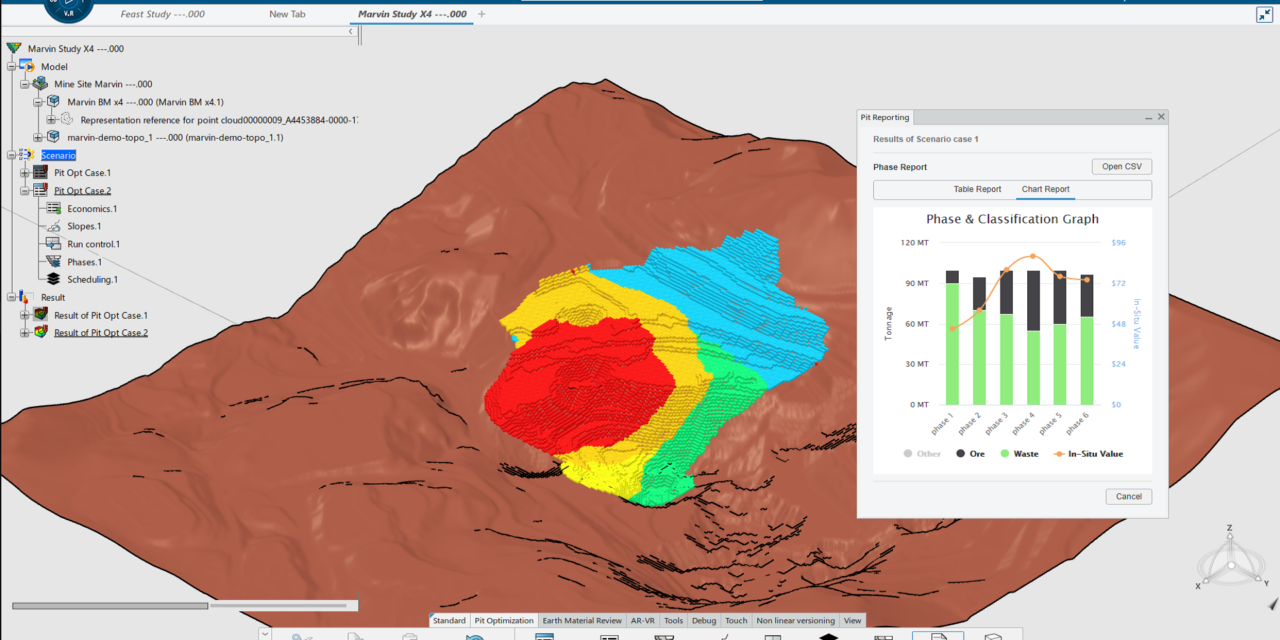
Open‑pit design always comes to a critical question: how big should the final pit be? This “ultimate pit” decision controls how much ore is mined, how long the mine runs, how much money is invested and earned, and how much land and environment is disturbed (Giannini, 1991; Díaz et al., 2021; Saleki, Kakaie and Ataei, 2019; Adibi, Ataee-Pour and Rahmanpour, 2015; Anisimov, Bariatska and Cherniaiev, 2024).
In practice, engineers and managers face a tension between two mindsets:
- “Maximize the pit” – push the pit as large as possible, extracting every tonne that still makes a (usually undiscounted) profit.
- “Optimize the pit” – choose the pit that gives the best overall outcome, usually measured as net present value (NPV), and increasingly also including environmental and social performance (Giannini, 1991; Xu et al., 2023; Saleki, Kakaie and Ataei, 2019; Adibi, Ataee-Pour and Rahmanpour, 2015; Ares et al., 2022; Anisimov, Bariatska and Cherniaiev, 2024).
The sections below explain what these approaches mean, which parameters they use, what indicators matter, and how to systematically choose an ultimate pit.
Where Ultimate Pit Selection Fits in the Mine Life Cycle
In a typical mine life cycle, the ultimate pit decision comes in the strategic planning phase:
- Geological exploration and resource modeling – build a 3D block model with grades, rock types, densities, etc. (Giannini, 1991; Ares et al., 2022; Liu and Kozan, 2015)2. Scoping / pre‑feasibility – test different mining methods and broad pit shapes; estimate rough economics.
- Feasibility – run pit optimization algorithms, generate nested pit shells, choose an ultimate pit, and build long‑term schedules (Giannini, 1991; Díaz et al., 2021; Ares et al., 2022; Anisimov, Bariatska and Cherniaiev, 2024; Liu and Kozan, 2015).
- Construction and operation – develop the pit in phases (pushbacks) inside the ultimate shell (Díaz et al., 2021; Ares et al., 2022; Anisimov, Bariatska and Cherniaiev, 2024).
- Closure and rehabilitation – backfilling (if any), recontouring, revegetation, and long‑term monitoring (Xu et al., 2023; Saleki, Kakaie and Ataei, 2019; Adibi, Ataee-Pour and Rahmanpour, 2015).
The “optimize vs maximize” choice is not a one‑time decision; it can be revisited as new drilling data, market prices, and environmental regulations appear, and as ecological and safety constraints are better understood (Giannini, 1991; Xu et al., 2023; Adibi, Ataee-Pour and Rahmanpour, 2015; Ares et al., 2022; Anisimov, Bariatska and Cherniaiev, 2024).
What “Maximize” and “Optimize” Mean in Open‑Pit Design
“Maximize the pit” – largest economic envelope
In classical terms, an ultimate pit is the contour that maximizes the difference between ore value and extraction cost (ore + waste), subject to slope safety and other basic constraints (Giannini, 1991; Díaz et al., 2021; Ares et al., 2022; Liu and Kozan, 2015). Many algorithms—Lerchs–Grossmann, floating cone, maximum flow—solve this “ultimate pit problem” based on per‑block profit values (Giannini, 1991; Díaz et al., 2021; Ares et al., 2022; Asad and Dimitrakopoulos, 2013; Liu and Kozan, 2015).
When people say “maximize the pit”, they often mean:
- Aim for the largest pit shell with non‑negative undiscounted profit (sum of block values ≥ 0) (Díaz et al., 2021; Saleki, Kakaie and Ataei, 2019; Ares et al., 2022; Anisimov, Bariatska and Cherniaiev, 2024).
- Focus on total ore and metal mined, total life of mine, and sometimes maximum production rate, with little or no discounting of future cash flows.
- Treat environmental and social impacts only loosely, or only as closure costs, not as strong constraints or penalties (Xu et al., 2023; Saleki, Kakaie and Ataei, 2019; Adibi, Ataee-Pour and Rahmanpour, 2015).
This approach tends to generate a larger ultimate pit, because low‑grade ore in deep or distant parts of the deposit can still look attractive if its small profit is not discounted or penalized by ecological costs (Díaz et al., 2021; Xu et al., 2023; Saleki, Kakaie and Ataei, 2019).
“Optimize the pit” – best overall value, not necessarily largest
An optimized pit is chosen from many possible pits (nested shells) based on a broader and more realistic objective:
- Economic optimization – choose the shell that maximizes NPV, not undiscounted profit. This automatically gives more weight to early, high‑value ore and less weight to late, marginal ore (Saleki, Kakaie and Ataei, 2019; Ares et al., 2022; Anisimov, Bariatska and Cherniaiev, 2024; Liu and Kozan, 2015).
- Technical feasibility – ensure that slopes, benches, ramps, and equipment can physically work; avoid impossible shapes or access problems (Giannini, 1991; Altuntov and Erkayaoğlu, 2021; Ares et al., 2022; Liu and Kozan, 2015).
- Risk and uncertainty – account for price volatility and grade uncertainty, for example through stochastic optimization or parametric price analysis (Díaz et al., 2021; Adibi, Ataee-Pour and Rahmanpour, 2015; Ares et al., 2022; Asad and Dimitrakopoulos, 2013).
- Environmental and social performance – subtract explicit ecological costs (carbon, land disturbance, loss of ecosystem services, reclamation) from block values, or use multi‑criteria decision tools that weigh profit together with environmental and social indicators (Xu et al., 2024; Mwangi et al., 2020; Xu et al., 2023; Saleki, Kakaie and Ataei, 2019; Adibi, Ataee-Pour and Rahmanpour, 2015).
In this broader sense, “optimize” does not always mean “smaller”. A sustainability‑focused optimized pit can even be larger than the pure‑profit pit if society is willing to accept lower financial returns in exchange for better employment or social outcomes (Mwangi et al., 2020; Saleki, Kakaie and Ataei, 2019). But if the goal is strictly “maximize NPV”, the optimized pit will always be a subset of, or equal to, the undiscounted maximum‑profit pit (Saleki, Kakaie and Ataei, 2019).
Algorithms that Generate Ultimate Pits
Ultimate pits are produced by optimization algorithms operating on a 3D block model. Key families are:
- Graph‑based rigorous methods – Lerchs–Grossmann, maximum flow, Dijkstra‑type methods. They guarantee an optimal undiscounted pit but can be computationally heavy for huge models (Giannini, 1991; Díaz et al., 2021; Najafi, Rafiee and Jalali, 2020; Asad and Dimitrakopoulos, 2013; Liu and Kozan, 2015).
- Cone‑based heuristic methods – floating cone and its many improvements. They are fast and flexible (especially for variable slopes), though not always strictly optimal (Xu et al., 2024; Turan and Onur, 2022; Altuntov and Erkayaoğlu, 2021; Ares et al., 2022).
- Hybrid and advanced methods – mixed‑integer programming with slope constraints, simulated annealing, maximum satisfiability, and parallel computing to handle large models (Altuntov and Erkayaoğlu, 2021; Deutsch, 2019; Petrov, Mikhelev and Petrova, 2021; Liu and Kozan, 2015).
All of these define the “maximize” pit as the set of blocks that maximizes the sum of per‑block values (usually undiscounted), subject to slope precedence (Giannini, 1991; Díaz et al., 2021; Ares et al., 2022; Asad and Dimitrakopoulos, 2013; Liu and Kozan, 2015). To move to an “optimize” mindset, planners do one more layer: they analyze a sequence of nested pits (or add extra costs/constraints) and then choose the shell that best satisfies broader objectives (Díaz et al., 2021; Ares et al., 2022; Anisimov, Bariatska and Cherniaiev, 2024; Liu and Kozan, 2015).
Parameters That Drive Ultimate Pit Shape
Whether optimizing or maximizing, the same broad groups of parameters enter the problem.
Geological and metallurgical parameters
- Ore grade, thickness, and geometry in each block.
- Rock types and geotechnical units.
- Metallurgical recoveries and penalties (e.g., deleterious elements).
These control which blocks are valuable and which are waste (Giannini, 1991; Ares et al., 2022; Liu and Kozan, 2015).
Economic parameters
- Commodity price (or price scenarios).
- Mining cost (drilling, blasting, loading, hauling).
- Processing and G&A costs.
- Royalties and taxes.
- Discount rate (for NPV; zero if maximizing undiscounted profit).
These parameters are combined into a block value, often:
Blocks with negative value are treated as waste and only mined if required to expose profitable blocks (Giannini, 1991; Díaz et al., 2021; Ares et al., 2022; Liu and Kozan, 2015).
Geotechnical and design parameters
- Bench height, berm width, bench face angle.
- Overall slope angle (OSA), possibly varying with depth and sector (Xu et al., 2024; Altuntov and Erkayaoğlu, 2021; Dehghan and Khodaei, 2021).
- Ramp width, gradient, and minimum pit bottom geometry.
Conventional algorithms historically struggled to handle complex variable slopes; newer cone‑based MIP approaches and cone IV methods directly integrate variable OSA into optimization, improving realism and profitability by 8–20% in test cases (Xu et al., 2024; Altuntov and Erkayaoğlu, 2021).
Environmental and social parameters
Optimization can explicitly include:
- Carbon emission factors and energy use.
- Land disturbance and loss of ecosystem services.
- Reclamation and post‑closure costs.
- Social metrics such as local employment, safety indicators, and proximity to communities (Xu et al., 2024; Mwangi et al., 2020; Xu et al., 2023; Saleki, Kakaie and Ataei, 2019; Adibi, Ataee-Pour and Rahmanpour, 2015).
Ecological costs can be converted to a monetary penalty per block. When these costs are included, the optimized pit often becomes smaller and shallower, because marginal blocks cannot cover both extraction and ecological costs (Xu et al., 2024; Xu et al., 2023).
Uncertainty parameters
- Probability distributions for grade, tonnage, and price.
- Correlations between variables.
Stochastic models use multiple realizations to design pits and schedules that respect uncertainty and still maximize expected NPV, or limit downside risk (Díaz et al., 2021; Adibi, Ataee-Pour and Rahmanpour, 2015; Asad and Dimitrakopoulos, 2013).
Summary of Key Parameters and Associated Indicators
Pit‑Selection Parameters and Indicators
| Dimension | Main Parameters | Indicators for “Maximize” mindset | Indicators for “Optimize” mindset |
|---|---|---|---|
| Economics | Price, cost, discount = 0 | Total ore, total metal, undiscounted profit, maximum pit volume | Peak NPV, IRR, payback, NPV sensitivity |
| Economics (discounted) | Price, cost, discount > 0 | Sometimes ignored | Discounted cash flow, time profile of cash flows |
| Geotechnical | OSA, benches, ramps | Largest safe pit with acceptable minimum factor of safety | NPV vs OSA trade‑off, slope reinforcement cost vs added value |
| Environment | Carbon factors, land cost, reclamation cost | Often only closure lump sum, or ignored | Ecological cost per block, GHG, disturbed area, SD indices |
| Uncertainty | Grade, price variability | Single base‑case scenario | Expected NPV, downside risk, scenario‑robust shell |
Figure 1: Key parameters and indicators affecting ultimate pit choice
How Discounting Changes “Maximize” vs “Optimize”
A central technical result is the relationship between pits built with and without discounting. When the objective is undiscounted profit maximization, the algorithm selects all blocks whose value contributes positively to total profit, regardless of how late they are mined (Giannini, 1991; Díaz et al., 2021; Ares et al., 2022). In contrast, a discounted NPV‑based optimization attaches lower weight to revenues far in the future; very deep or marginal blocks might no longer be worth it.
Mathematically, it has been proven that:
- The discounted ultimate pit is always a subset of, or equal to, the undiscounted pit (Saleki, Kakaie and Ataei, 2019).
- In other words, discounting never makes the pit larger; it only potentially removes marginal areas that are profitable in total but do not justify their delayed, discounted cash flows (Saleki, Kakaie and Ataei, 2019).
This directly links maximize (undiscounted profit) with optimize (NPV):
- If the goal is total profit, ignoring time, the maximizing pit will be the largest economic shell.
- If the goal is NPV, the optimizing pit will be somewhere inside that shell, often noticeably smaller and sometimes much shallower (Saleki, Kakaie and Ataei, 2019; Ares et al., 2022; Anisimov, Bariatska and Cherniaiev, 2024).
Environmental and Ecological Costs: Shrinking the Pit
Recent work has quantified ecological costs and fed them into ultimate pit optimization:
- Ecological service value loss (loss of grassland, forests, water regulation, etc.).
- Reclamation costs for disturbed land.
- Carbon emission costs from fuel and power consumption (Xu et al., 2024; Xu et al., 2023).
By introducing an ecological cost per block, optimization algorithms can compute new ultimate pits:
- When ecological costs are ignored, the pit tends to be larger, with more waste and ore, but at the expense of higher total environmental damage.
- When ecological costs are included, the optimized ultimate pit becomes smaller, with higher average economic and ecological efficiency, and some low‑margin areas are dropped because they cannot cover their ecological penalty (Xu et al., 2024; Xu et al., 2023).
In arid or semi‑arid regions, ecological costs can exceed 20% of the mine’s pure economic gains, making it clear that a purely financial “maximize” pit is misleading from a sustainability viewpoint (Xu et al., 2024).
Integrating Slope Safety into Optimization
To physically stand up, a pit must meet geotechnical constraints. Two key ideas:
- Overall Slope Angle (OSA): the average angle from crest to bottom. Steeper OSA increases ore recovered and reduces waste but lowers the factor of safety and raises failure probability (Xu et al., 2024; Altuntov and Erkayaoğlu, 2021; Dehghan and Khodaei, 2021).
- Bench design: bench height, bench face angle, and berm width are tuned to keep rock slopes stable (Xu et al., 2024; Dehghan and Khodaei, 2021).
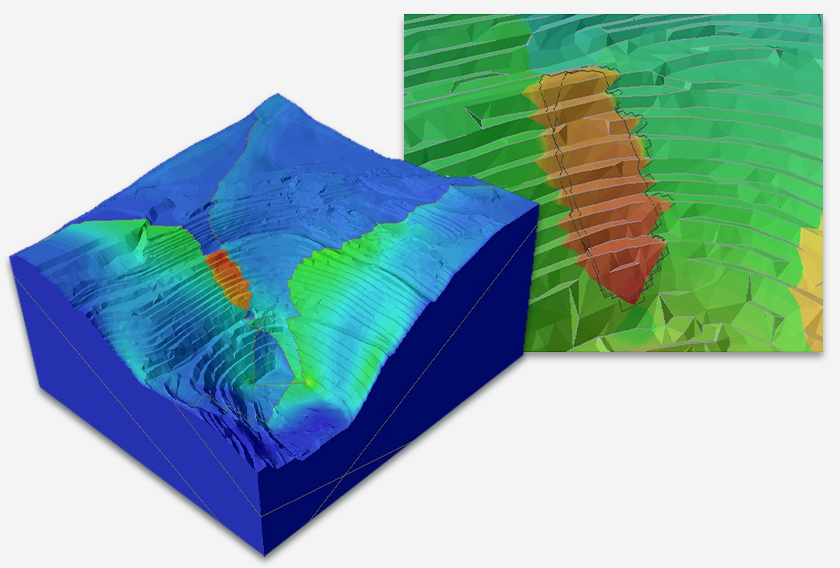
New mathematical models now allow variable OSA around the pit, implemented through mixed‑integer programming and simulated annealing. This yields:
- Realistic treatment of weaker and stronger rock sectors.
- Ultimate pits whose actual OSA differs only 0–2° from target while improving pit economic value by 8–20% versus standard Lerchs–Grossmann (Altuntov and Erkayaoğlu, 2021).
Separately, detailed 3D numerical modeling (e.g., FLAC3D with shear strength reduction) can be used to test different slope geometries and ensure that the ultimate slope meets a target factor of safety (often 1.2 or higher) (Dehghan and Khodaei, 2021).
From a maximize viewpoint, the pressure is to steepen slopes to increase pit size and ore. An optimize approach weighs:
- Marginal value of extra ore from steeper slopes,
against - Probability and cost of slope failure and reinforcement (Xu et al., 2024; Altuntov and Erkayaoğlu, 2021; Dehghan and Khodaei, 2021).
The chosen ultimate pit then reflects a rational trade‑off between value and safety.
From Algorithm Output to Practical Pits: Nested Shells and Pushbacks
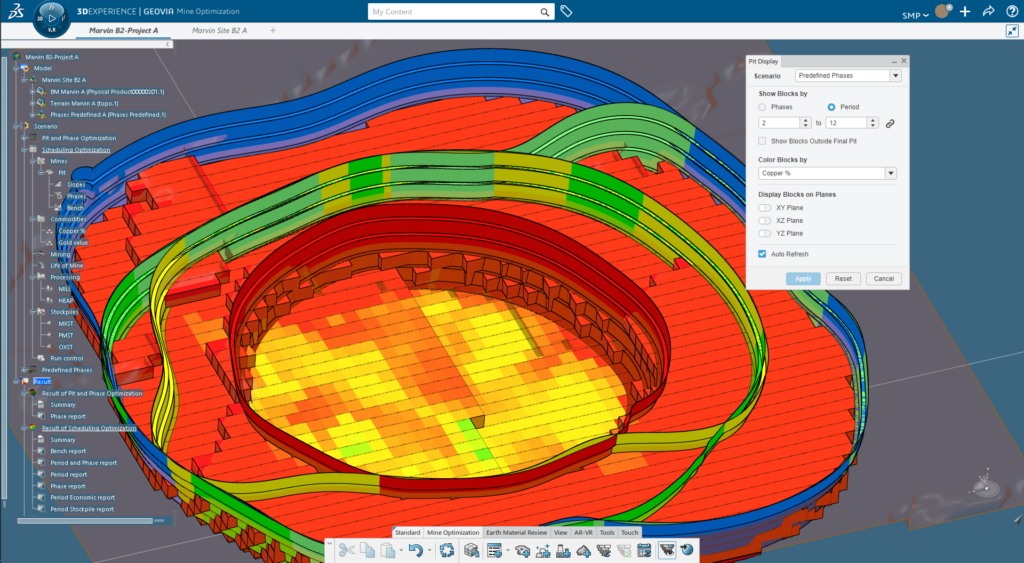
Most commercial optimizers produce nested pit shells:
- Shell 1 – small, very high grade, short life, high NPV density.
- Shell 2, 3, … – progressively larger, lower average grade, longer life.
- Final shell – largest undiscounted profitable pit (the “maximize” ultimate pit) (Díaz et al., 2021; Ares et al., 2022; Anisimov, Bariatska and Cherniaiev, 2024; Liu and Kozan, 2015).
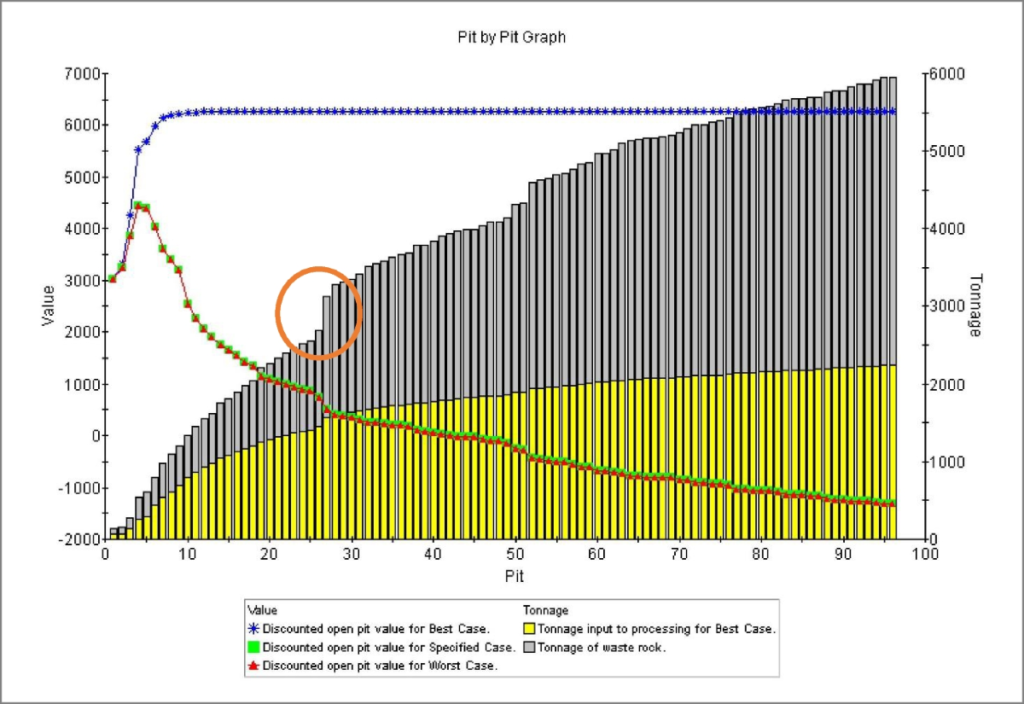
The optimize vs maximize decision is usually made by:
- Calculating discounted cash flow for different shells and mining sequences (Díaz et al., 2021; Ares et al., 2022; Anisimov, Bariatska and Cherniaiev, 2024).
- Plotting NPV vs shell number.
- Choosing the shell where NPV peaks or where a chosen sustainable development index is best (Mwangi et al., 2020; Saleki, Kakaie and Ataei, 2019; Anisimov, Bariatska and Cherniaiev, 2024).
Software Geovia Whittle Beyond optimizer does this by:
- Using Lerchs–Grossmann or similar algorithms to build nested shells (ultimate vs nested pits).
- Evaluating future discounted cash flows for different shells and sequences.
- Highlighting which shell maximizes NPV, often called the optimal pit shell (Anisimov, Bariatska and Cherniaiev, 2024; Asad and Dimitrakopoulos, 2013; Liu and Kozan, 2015).
This process operationalizes “optimize” as select the shell that maximizes discounted value, not simply the largest shell.
Adding Sustainable Development (SD) Criteria
Classically, ultimate pits are chosen solely on profit maximization. However, sustainable development adds three pillars:
- Economic – profit, NPV, unit costs.
- Environmental – emissions, land disturbance, water impact.
- Social – employment, safety, community impacts (Mwangi et al., 2020; Xu et al., 2023; Saleki, Kakaie and Ataei, 2019; Adibi, Ataee-Pour and Rahmanpour, 2015).
A practical way to include SD is:
- Generate several candidate ultimate pits (shells) using a profit‑driven optimizer.
- Compute SD indicators for each shell (e.g., ore tonnes, profit, disturbed area, CO₂ emissions, employment).
- Treat pit selection as a multi‑attribute decision‑making (MADM) problem.
- Use methods like TOPSIS to rank shells and select the one closest to an “ideal” combination of high profit, low impact, and good social performance (Mwangi et al., 2020).
In one copper mine case, the SD‑based ultimate pit was:
- Larger than the purely economic optimum,
- Contained more ore,
- But had lower financial profit (Mwangi et al., 2020).
This is a clear example where “optimize” means “best for SD objectives”, not “maximum NPV”. The chosen pit strikes a compromise between financial and broader societal goals.
Handling Uncertainty: Stochastic Optimization
Traditional ultimate pit design uses single values for prices and grades. In reality, both are uncertain:
- Prices fluctuate with markets.
- Grades vary spatially and estimation models are imperfect.
Stochastic frameworks handle this by:
- Creating several realizations of the orebody and economic parameters.
- Building a graph‑based model that encodes these multiple scenarios.
- Solving an optimization problem that maximizes expected discounted value while honoring capacity constraints, often using parametric maximum flow and Lagrangian relaxation (Adibi, Ataee-Pour and Rahmanpour, 2015; Asad and Dimitrakopoulos, 2013).
Outputs are:
- Production phases and ultimate pit limits that are more robust to uncertainty.
- Better control of downside risk compared with simple deterministic maximize‑profit pits (Adibi, Ataee-Pour and Rahmanpour, 2015; Asad and Dimitrakopoulos, 2013).
In “optimize vs maximize” language, stochastic approaches clearly favor optimize, because they explicitly manage risk and capacity over time.
A Practical Framework to Choose Between Optimize and Maximize
When standing in front of the optimizer outputs and several possible ultimate pits, it helps to use a structured process.
Step 1 – Clarify corporate objectives
Discuss with management and stakeholders:
- Is the primary goal maximum NPV, maximum total metal, longer life, better SD performance, or a combination?
- What discount rate, carbon price, or ecological penalties should be used? (Xu et al., 2024; Mwangi et al., 2020; Xu et al., 2023; Saleki, Kakaie and Ataei, 2019)This step defines whether “optimize” means NPV, SD index, or some hybrid.
Step 2 – Build and validate the block model
Ensure the geological and geometallurgical model is robust; garbage in, garbage out:
- Validate grades, densities, and ore/waste boundaries.
- Assign realistic recoveries and penalties.
- Define geotechnical units for variable slopes (Giannini, 1991; Altuntov and Erkayaoğlu, 2021; Ares et al., 2022; Liu and Kozan, 2015).
Step 3 – Run profit‑based pit optimization (“maximize stage”)
Using Lerchs–Grossmann, floating cone IV, or equivalent:
- Assign block values ignoring discounting (profit per block).
- Generate the ultimate (undiscounted) pit and nested shells (Giannini, 1991; Díaz et al., 2021; Turan and Onur, 2022; Ares et al., 2022; Anisimov, Bariatska and Cherniaiev, 2024; Liu and Kozan, 2015).
- This gives the maximize envelope – the largest pit that makes non‑negative profit.
Step 4 – Analyze NPV and SD indicators across shells (“optimize stage”)
For each key shell (e.g., every 5th or 10th), build simplified long‑term schedules:
- Estimate NPV, IRR, payback period, ore and waste tonnages, average grades.
- Compute environmental indicators (disturbed area, GHG, reclamation cost) and social indicators if possible (Xu et al., 2024; Mwangi et al., 2020; Xu et al., 2023; Saleki, Kakaie and Ataei, 2019; Adibi, Ataee-Pour and Rahmanpour, 2015; Anisimov, Bariatska and Cherniaiev, 2024).
- Plot NPV vs shell number and optionally SD scores vs shell number.
Now you can see:
- Where NPV peaks,
- How fast it drops beyond the optimum,
- How environmental and social impacts worsen with pit size.
Step 5 – Evaluate geotechnical safety and slope design
For promising shells (maximize and optimize candidates):
- Check whether assumed OSAs and benches are realistic.
- Use numerical modeling for critical walls to confirm factor of safety ≥ target (e.g., 1.2) (Xu et al., 2024; Altuntov and Erkayaoğlu, 2021; Dehghan and Khodaei, 2021).
- If required, adjust slopes and rerun optimization or apply variable OSA methods (Altuntov and Erkayaoğlu, 2021; Dehghan and Khodaei, 2021).
Step 6 – Consider ecological costs explicitly
If environmental performance is a priority:
- Assign ecological costs to blocks and re‑run ultimate pit optimization including these costs.
- Compare the ecological‑cost‑based pit with the purely economic pit: size, profit, ecological indicators (Xu et al., 2024; Xu et al., 2023).
- Decide whether to adopt the ecological pit or find a compromise using MADM / TOPSIS (Mwangi et al., 2020; Xu et al., 2023; Saleki, Kakaie and Ataei, 2019).
Step 7 – Incorporate uncertainty if material
If prices or grades are highly uncertain and the project is long‑lived:
- Use stochastic pit optimization to design phases and ultimate pits under multiple scenarios (Díaz et al., 2021; Adibi, Ataee-Pour and Rahmanpour, 2015; Asad and Dimitrakopoulos, 2013).
- Compare stochastic designs to deterministic designs to understand robustness and risk.
Step 8 – Select and document the preferred ultimate pit
After comparing maximize and optimize options:
- Choose the pit that best matches the stated objectives and risk tolerance.
- Clearly document why, for example:
- “Shell 30 (optimized) has 8% less metal than Shell 40 (maximize) but 15% higher NPV and 25% less disturbed area.”
- “Ecological costs make deeper blocks unprofitable; the optimized ecological pit is 10% smaller but avoids 20% of ecological damage.” (Xu et al., 2024; Mwangi et al., 2020; Xu et al., 2023; Saleki, Kakaie and Ataei, 2019; Anisimov, Bariatska and Cherniaiev, 2024)- Define pushbacks and schedules inside this shell (Díaz et al., 2021; Ares et al., 2022; Anisimov, Bariatska and Cherniaiev, 2024).
How to Communicate “Optimize vs Maximize” to Stakeholders
Different stakeholders may equate “bigger pit” with “better project”. To avoid misunderstandings:
- Use simple graphs showing NPV vs pit size, and impact vs pit size, to illustrate the trade‑offs.
- Explain that the maximized pit is like squeezing every last cent out of the deposit ignoring time value, whereas the optimized pit respects the value of money, risk, safety, and the environment.
- Show that in many cases, a slightly smaller pit gives significantly higher NPV and/or far better environmental and social outcomes.
Conclusion
In open‑pit design, “maximize” and “optimize” are not just words; they represent different philosophies of value:
- Maximize: largest economically mineable shell under basic constraints, built on undiscounted block values and often limited attention to environment and uncertainty (Giannini, 1991; Díaz et al., 2021; Xu et al., 2023; Ares et al., 2022; Anisimov, Bariatska and Cherniaiev, 2024; Liu and Kozan, 2015).
- Optimize: choose, among many shells, the one that best balances NPV, safety, risk, and sustainable development indicators, possibly including explicit ecological costs and SD ranking methods (Xu et al., 2024; Mwangi et al., 2020; Xu et al., 2023; Saleki, Kakaie and Ataei, 2019; Adibi, Ataee-Pour and Rahmanpour, 2015; Anisimov, Bariatska and Cherniaiev, 2024; Asad and Dimitrakopoulos, 2013; Dehghan and Khodaei, 2021).
Technically, the optimized discounted pit will always be contained in, or equal to, the maximized undiscounted pit (Saleki, Kakaie and Ataei, 2019). Practically, choosing between them means deciding what kind of “best” a project is aiming for—best total tonnage, best discounted return, or best overall sustainability profile.
Using the framework above, you can turn ultimate pit selection from a black‑box optimizer output into a transparent, well‑reasoned decision that balances optimization and maximization in a way that fits the mine’s long‑term strategy.
References
Xu, X., Zhu, Z., Ye, L., Gu, X., Wang, Q., Zhao, Y., Liu, S., & Zhao, Y., 2024. Ultimate Pit Limit Optimization Method with Integrated Consideration of Ecological Cost, Slope Safety and Benefits: A Case Study of Heishan Open Pit Coal Mine. Sustainability. https://doi.org/10.3390/su16135393
Giannini, L., 1991. Optimum design of open pit mines. Bulletin of the Australian Mathematical Society, 43, pp. 349 – 350. https://doi.org/10.1017/s0004972700029154
Díaz, A., Álvarez, I., Fernández, C., Krzemień, A., & Rodríguez, F., 2021. Calculating ultimate pit limits and determining pushbacks in open-pit mining projects. Resources Policy, 72, pp. 102058. https://doi.org/10.1016/j.resourpol.2021.102058
Mwangi, A., Jianhua, Z., Gang, H., Kasomo, R., & Innocent, M., 2020. Ultimate Pit Limit Optimization Methods in Open Pit Mines: A Review. Journal of Mining Science, 56, pp. 588 – 602. https://doi.org/10.1134/s1062739120046885
Turan, G., & Onur, A., 2022. Optimization of open-pit mine design and production planning with an improved floating cone algorithm. Optimization and Engineering, 24, pp. 1157-1181. https://doi.org/10.1007/s11081-022-09725-4
Xu, X., Gu, X., Wang, Q., Zhao, Y., Zhu, Z., Wang, F., & Zhang, Z., 2023. Ultimate pit optimization with environmental problem for open-pit coal mine. Process Safety and Environmental Protection. https://doi.org/10.1016/j.psep.2023.03.024
Altuntov, F., & Erkayaoğlu, M., 2021. A New Approach to Optimize Ultimate Geometry of Open Pit Mines with Variable Overall Slope Angles. Natural Resources Research, 30, pp. 4047 – 4062. https://doi.org/10.1007/s11053-021-09911-8
Saleki, M., Kakaie, R., & Ataei, M., 2019. Mathematical relationship between ultimate pit limits generated by discounted and undiscounted block value maximization in open pit mining. Journal of Sustainable Mining. https://doi.org/10.1016/j.jsm.2019.03.003
Adibi, N., Ataee-Pour, M., & Rahmanpour, M., 2015. Integration of sustainable development concepts in open pit mine design. Journal of Cleaner Production, 108, pp. 1037-1049. https://doi.org/10.1016/j.jclepro.2015.07.150
Ares, G., Fernández, C., Álvarez, I., Arias, D., & Díaz, A., 2022. Open Pit Optimization Using the Floating Cone Method: A New Algorithm. Minerals. https://doi.org/10.3390/min12040495
Deutsch, M., 2019. Open-Pit Mine Optimization with Maximum Satisfiability. Mining, Metallurgy & Exploration, 36, pp. 757 – 764. https://doi.org/10.1007/s42461-019-0062-x
Najafi, M., Rafiee, R., & Jalali, S., 2020. Open pit limit optimization using dijkstra’s algorithm. **, 54, pp. 39-43. https://doi.org/10.22059/ijmge.2019.252822.594718
Asad, M., & Dimitrakopoulos, R., 2013. Implementing a parametric maximum flow algorithm for optimal open pit mine design under uncertain supply and demand. Journal of the Operational Research Society, 64, pp. 185-197. https://doi.org/10.1057/jors.2012.26
Petrov, D., Mikhelev, V., & Petrova, E., 2021. Method for optimizing the shell of open pit mines based on parallel computing. Journal of Physics: Conference Series, 1715. https://doi.org/10.1088/1742-6596/1715/1/012070
Liu, S., & Kozan, E., 2015. New graph-based algorithms to efficiently solve large scale open pit mining optimisation problems. Expert Syst. Appl., 43, pp. 59-65. https://doi.org/10.1016/j.eswa.2015.08.044
Dehghan, A., & Khodaei, M., 2021. Stability Analysis and Optimal Design of Ultimate Slope of an Open Pit Mine: A Case Study. Geotechnical and Geological Engineering, 40, pp. 1789 – 1808. https://doi.org/10.1007/s10706-021-01993-8