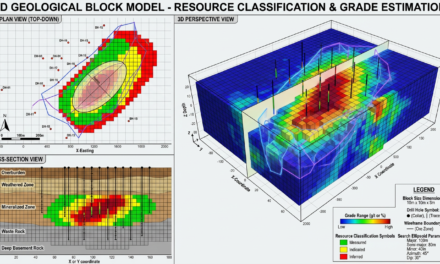
Role of the Block Model in Planning
A resource block model becomes useful to mine planning only when it is deliberately designed, populated and post‑processed with planning decisions in mind. The connection is both conceptual (what variables you model) and procedural (how you pass the model into design and scheduling tools).
A block model is the main input to pit design, scheduling and economic evaluation: each block carries grades, density, rock type and other attributes that are turned into economic value and technical constraints for optimization (Morales et al., 2019; Maleki et al., 2020; Asl and Sattarvand, 2018). Block models are standard for reserve estimation, pit optimization and mine planning, including extraction sequences (Rezaei and Fallahi, 2023; Morales et al., 2019; Maleki et al., 2020).
To be “planning‑ready”, a resource model must:
- Use a block/SMU size consistent with drilling spacing, orebody geometry and mining method (Rezaei and Fallahi, 2023; Maleki et al., 2020; Guo et al., 2024).
- Contain all attributes required to compute per‑block value and constraints (grades, density, rock type, recoveries, etc.) (Morales et al., 2019; Maleki et al., 2020; Reis et al., 2021).
- Reflect geotechnical and operational considerations that influence pit slopes, equipment access and workability (Campos et al., 2025; Mussin et al., 2025; Guo et al., 2024).
Choosing Block and SMU Size
Block geometry links geology to equipment and pit design. Too large blocks lose selectivity; too small blocks are computationally prohibitive or operationally unrealistic (Rezaei and Fallahi, 2023; Maleki et al., 2020; Guo et al., 2024). Guidance includes:
- Block size often set at roughly ½–⅓ of drill spacing, balancing estimation accuracy and planning resolution (Rezaei and Fallahi, 2023).
- Dimensions should respect bench height, slope angle and shovel width, aligning blocks with real mining geometries and shovel–truck performance (Mussin et al., 2025; Guo et al., 2024).
- Selective Mining Unit (SMU) is the smallest practical mining unit; block size in resource estimation should be compatible with SMU so that estimated recoverable tonnages resemble actual production (Guo et al., 2024).
Studies show that tuning block size to match drilling grid and equipment configuration reduces dilution and ore losses and supports better equipment selection and slope design (Mussin et al., 2025; Guo et al., 2024).
Adding Planning‑Relevant Attributes
Beyond grade, several attributes are critical for planning:
- Density / bulk density: Needed to convert volume to tonnage and metal content. Ignoring density variability can distort Life‑of‑Mine (LOM) and Net Present Value (NPV) by several percent and alter pit designs (Reis et al., 2021).
- Rock type and geomechanics: Rock mass strength, stress and orebody geometry can be embedded as “ranked” or geotechnical attributes per block, supporting selection of mining methods, ground support, and sequence in underground or high‑risk areas (Campos et al., 2025).
- Geometallurgical variables: Recovery, processing time, specific energy in comminution and other processing parameters can be stored per block, then used in pit limit and scheduling optimization to better reflect plant performance and risk (Morales et al., 2019; Maleki et al., 2020; Mata, Nader and Mazzinghy, 2022).
- Operational tags: Bench, phase/pushback, or pre‑assigned destinations can be added later, but the resource model must be rich enough to support such derivations.
From Resource Model to Economic Block Model
Mine planning first transforms the geological block model into an economic block model:
- For each block, combine grades, density and recoveries with long‑term prices and mining/processing costs to compute economic value (Morales et al., 2019; Maleki et al., 2020; Asl and Sattarvand, 2018).
- Classify blocks as ore or waste based on cutoff and value; alternative destinations (plant, stockpile, waste) can be encoded with separate values (Maleki et al., 2020; Mata, Nader and Mazzinghy, 2022; Asl and Sattarvand, 2018).
- Optionally aggregate small blocks into clusters to reduce problem size while controlling grade deviation and maintaining contiguous shapes for scheduling (Aalian, Mousavi and Bsiri, 2022).
This economic model directly drives pit limit optimization and sequencing decisions (Morales et al., 2019; Maleki et al., 2020; Campos, Arroyo and Morales, 2018; Asl and Sattarvand, 2018).
Using the Block Model in Long‑Term Planning
Ultimate Pit Limit and Mineable Reserves
Pit optimization algorithms treat each block as a node with value and slope precedence constraints. The block model defines:
- Which volumes are potentially mineable (ore and waste blocks) (Rezaei and Fallahi, 2023; Morales et al., 2019; Maleki et al., 2020).
- Slope constraints derived from geotechnical parameters and bench geometries stored or linked to blocks (Morales et al., 2019; Maleki et al., 2020).
Multiple realizations of grades and geometallurgical attributes can be used to generate scenario‑specific pits and then a reliable single ultimate pit based on probabilistic criteria (Morales et al., 2019).
Life‑of‑Mine (LOM) Production Scheduling
Scheduling models then decide when each block or block group is mined, subject to:
- Mining and processing capacities.
- Pit slope and precedence (no mining under unsupported blocks).
- Blending and quality requirements.
- Possibly operational space constraints such as minimum mining width or number of active fronts (Nancel-Penard and Jélvez, 2023; Campos, Arroyo and Morales, 2018; Asl and Sattarvand, 2018).
The block model is the core data structure for these optimization formulations (Nancel-Penard and Jélvez, 2023; Morales et al., 2019; Maleki et al., 2020; Campos, Arroyo and Morales, 2018; Asl and Sattarvand, 2018).
Integrating Uncertainty
Simulation‑based resource models yield multiple equiprobable block models. These feed stochastic scheduling:
- Each realization is planned, or multiple realizations are combined, to assess risk on ore tonnes, grades and NPV (Morales et al., 2019; Maleki et al., 2020; Neves, Araújo and Soares, 2020).
- Methods exist to convert per‑block grade uncertainty into period‑by‑period production uncertainty, which can be used as an explicit optimization target or constraint in planning (Neves, Araújo and Soares, 2020).
Stochastic models generally increase expected cash flows and reduce downside risk relative to plans built on a single deterministic model (Morales et al., 2019; Maleki et al., 2020).

Short‑Term Planning and Dynamic Models
The same principles extend to shorter horizons:
- Dynamic block models can represent stockyards, tracking tonnage and grade of stored material for reclaim scheduling and plant feed control (Huaman, Ullah and Tomi, 2025).
- In underground or complex deposits, ranked or prepared‑reserve block models support scheduling that guarantees a minimum volume of developed reserves ahead of stoping, improving rhythm and quality stability (Campos et al., 2025; Rysbekov et al., 2020).
Practical Steps to “Connect” Your Resource Work to Planning
- Design block/SMU size with planners and engineers, using drill spacing, SMU theory and equipment/bench parameters (Mussin et al., 2025; Rezaei and Fallahi, 2023; Guo et al., 2024).
- Populate all planning‑critical attributes (grades, density, rock type, key geometallurgical variables) and validate them geostatistically (Rezaei and Fallahi, 2023; Morales et al., 2019; Maleki et al., 2020; Reis et al., 2021).
- Build an economic block model: compute per‑block values and destination logic for use by pit optimization and scheduling tools (Morales et al., 2019; Maleki et al., 2020; Asl and Sattarvand, 2018).
- Support uncertainty analysis by generating simulations or at least quantifying density and grade uncertainty for integration into stochastic planning (Morales et al., 2019; Maleki et al., 2020; Reis et al., 2021; Neves, Araújo and Soares, 2020).
- Iterate with mine planners: use feedback from pit and schedule optimization (e.g., sensitivity to block size, density, recovery) to refine domains, estimation parameters and attributes (Coombes, Tran and Earl, 2020).
Connecting resource estimation to mine planning is therefore not a one‑way transfer of a static model. It is an iterative, integrated process in which the block model is tailored to support realistic, value‑driven design and scheduling decisions.
References
Campos, M., Schroeder, J., Silva, R., & Vigário, H., 2025. Ranked Block Model, an integration of rockmass behavior and mining characteristics into a resource model. 59th U.S. Rock Mechanics/Geomechanics Symposium. https://doi.org/10.56952/arma-2025-0695
Nancel-Penard, P., & Jélvez, E., 2023. A direct block scheduling model considering operational space requirement for strategic open-pit mine production planning. Optimization and Engineering, 25, pp. 2149 – 2175. https://doi.org/10.1007/s11081-023-09875-z
Mussin, R., Yachsishin, M., Golik, A., & Akhmatnurov, D., 2025. Block modeling reserves estimation. Kompleksnoe Ispolzovanie Mineralnogo Syra = Complex Use of Mineral Resources. https://doi.org/10.31643/2026/6445.44
Rezaei, M., & Fallahi, S., 2023. BLOCK MODEL OPTIMIZATION AND RESOURCE ESTIMATION OF THE ANGOURAN MINE BY TRANSFERRING THE EXPLORATORY DATA FROM THE LOCAL COORDINATE SYSTEM TO THE UTM. Rudarsko-geološko-naftni zbornik. https://doi.org/10.17794/rgn.2023.3.1
Morales, N., Seguel, S., Caceres, A., Jélvez, E., & Alarcón, M., 2019. Incorporation of Geometallurgical Attributes and Geological Uncertainty into Long-Term Open-Pit Mine Planning. Minerals. https://doi.org/10.3390/min9020108
Aalian, Y., Mousavi, A., & Bsiri, M., 2022. A new mathematical model for the optimization of block aggregation in open pit mines. Mining Technology, 131, pp. 149 – 158. https://doi.org/10.1080/25726668.2022.2064260
Maleki, M., Jélvez, E., Emery, X., & Morales, N., 2020. Stochastic Open-Pit Mine Production Scheduling: A Case Study of an Iron Deposit. Minerals. https://doi.org/10.3390/min10070585
Guo, W., Liu, G., Li, J., Chai, S., & Guo, S., 2024. Research on the method of determining the block size for an open-pit mine integrating mining parameters and shovel-truck’s operation efficiency. Scientific Reports, 14. https://doi.org/10.1038/s41598-024-52815-9
Rysbekov, K., Toktarov, A., Tursyn, K., Moldabayev, S., Yessezhulov, T., & Bakhmagambetova, G., 2020. Mine planning subject to prepared ore reserves rationing. E3S Web of Conferences. https://doi.org/10.1051/e3sconf/202016800016
Campos, P., Arroyo, C., & Morales, N., 2018. Application of optimized models through direct block scheduling in traditional mine planning. Journal of The South African Institute of Mining and Metallurgy, 118, pp. 381-386. https://doi.org/10.17159/2411-9717/2018/v118n4a8
Mata, J., Nader, A., & Mazzinghy, D., 2022. Inclusion of the geometallurgical variable specific energy in the mine planning using direct block scheduling. Tecnologia em Metalurgia, Materiais e Mineração. https://doi.org/10.4322/2176-1523.20222677
Huaman, R., Ullah, I., & Tomi, G., 2025. Stockyard management integrated into short-term mine planning using dynamic block modeling. REM – International Engineering Journal. https://doi.org/10.1590/0370-44672024780040
Reis, C., Arroyo, C., Curi, A., & Zangrandi, M., 2021. Impact of bulk density estimation in mine planning. Mining Technology, 130, pp. 60 – 65. https://doi.org/10.1080/25726668.2021.1876481
Asl, M., & Sattarvand, J., 2018. Integration of commodity price uncertainty in long-term open pit mine production planning by using an imperialist competitive algorithm. Journal of The South African Institute of Mining and Metallurgy, 118, pp. 165-172. https://doi.org/10.17159/2411-9717/2018/v118n2a10
Neves, J., Araújo, C., & Soares, A., 2020. Uncertainty Integration in Dynamic Mining Reserves. Mathematical Geosciences, 53, pp. 737-755. https://doi.org/10.1007/s11004-020-09866-1
Coombes, J., Tran, T., & Earl, A., 2020. Going local – innovating resource estimates to improve investment decisions. Mineral Processing and Extractive Metallurgy, 129, pp. 1 – 11. https://doi.org/10.1080/25726641.2020.1725324